
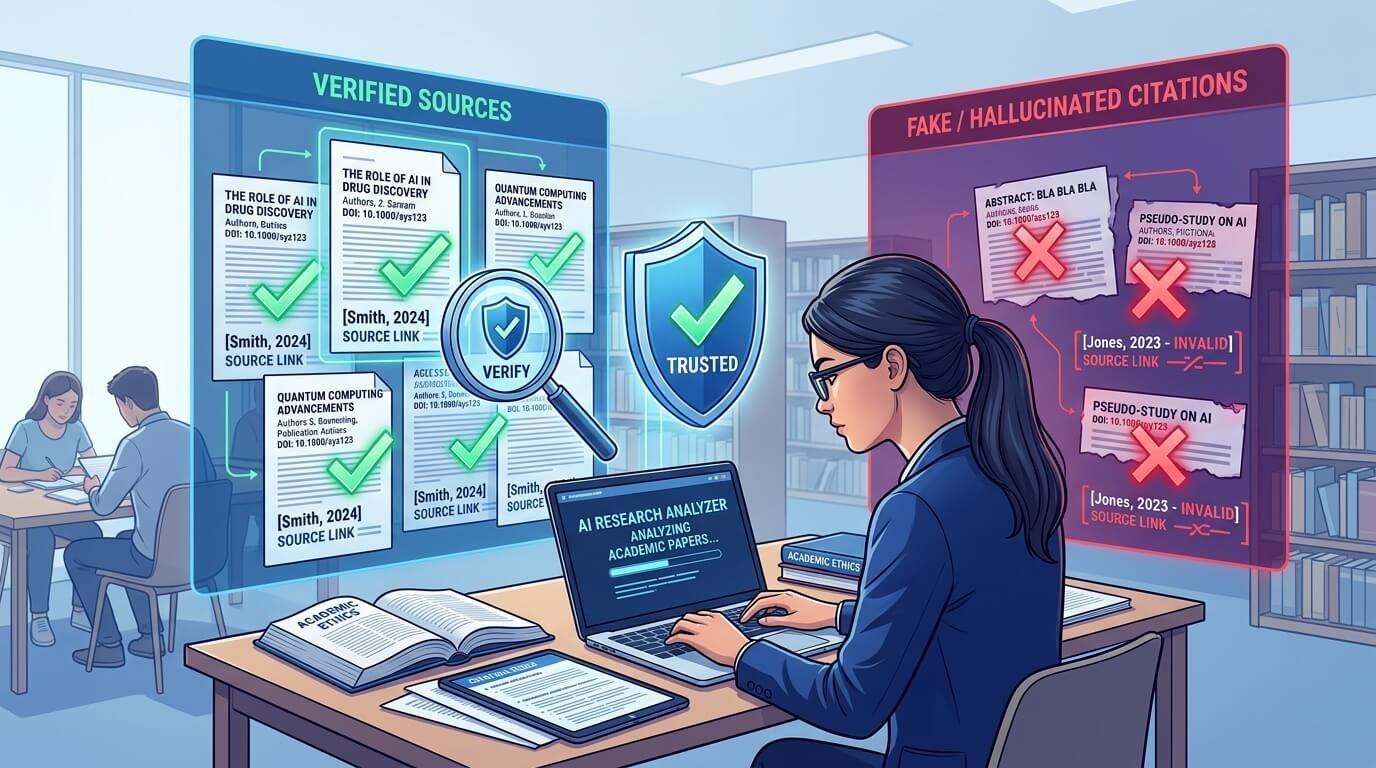
How to Use AI for Research Without Fake Citations starts with understanding one uncomfortable fact: an AI system can produce a citation that looks completely legitimate even when the cited paper, author, journal, DOI, or quotation does not exist. This happens because generative AI is designed to produce plausible language, not to function as a perfect academic database. When you ask an AI tool to find supporting sources, it may generate a polished-looking reference based on patterns it has learned rather than retrieving and verifying a real publication. The result can be especially dangerous because fabricated references rarely look obviously fake. A nonexistent article can have a convincing title, realistic author names, a familiar journal, a publication year, and even a DOI-shaped string. If you are writing an academic paper, business report, blog article, dissertation, or research-backed presentation, blindly accepting that information can undermine the credibility of everything around it. The problem is not necessarily that AI is intentionally misleading you; rather, it can confidently fill gaps when it does not have reliable evidence available. That distinction matters. Treat AI as a research assistant that helps you discover possibilities, organize information, explain difficult concepts, and generate questions—not as the final authority on whether a source exists. A useful mindset is to separate discovery from verification. AI can suggest what to investigate, while trustworthy databases, publisher pages, government websites, books, institutional repositories, and original documents establish what is actually true. Once you adopt that workflow, the technology becomes much safer and more useful. You stop asking, “Can I trust this citation because it sounds right?” and start asking, “Can I independently locate and verify the source?” That single change dramatically reduces the chance of publishing fabricated evidence.
Understand What an AI Citation Actually Means
When learning How to Use AI for Research Without Fake Citations, it helps to distinguish between a citation generated from a verified retrieval system and a citation produced through ordinary text generation. Those two situations can look identical on the screen while being fundamentally different underneath. If an AI tool has access to a connected academic database, a web search system, or a document collection and provides links to sources it actually retrieved, you have a stronger starting point. Even then, however, the source still deserves inspection because retrieval systems can surface irrelevant, outdated, duplicated, or incorrectly interpreted material. A language model operating without reliable source retrieval may instead construct a reference from learned associations. Imagine asking a highly articulate person to remember a book they read years ago. They might remember the subject, the author’s name, and roughly when it was published, but accidentally combine details from several books into one convincing description. Generative AI can make similar mistakes at enormous speed. This is why citation formatting alone proves almost nothing. A reference such as “Smith, J. (2022). Artificial Intelligence and Research Integrity. Journal of Digital Scholarship, 18(2), 44–59” may look professional, but appearance is not evidence. You need to determine whether the article exists, whether Smith actually wrote it, whether the journal published it, and whether the cited passage supports your claim. The same principle applies to quotations. Never assume a quotation is authentic simply because quotation marks surround it and an author is named. Ask for the original source, locate the document, search for the exact wording, and check the surrounding context. In practical terms, AI-generated references should initially be treated as leads, not as confirmed evidence. Once you make that distinction part of your routine, you can use AI aggressively for brainstorming while keeping your research standards firmly under human control.
Start With a Research Question, Not a Citation Request
One of the most effective ways to practice How to Use AI for Research Without Fake Citations is to avoid starting your research session with a request such as “Give me 20 scholarly sources about this topic.” That prompt encourages the system to produce a list of references whether or not it has reliable access to the relevant literature. A better approach begins with the actual research problem. Ask the AI to help you narrow the question, identify competing explanations, define unfamiliar terminology, map major themes, or suggest search concepts. For example, instead of requesting sources about remote work productivity, you might ask the AI to identify the variables researchers commonly use when studying remote-work performance and to distinguish employee-level, organizational, and environmental factors. That gives you a conceptual map before you begin collecting evidence. You can then convert those concepts into search queries for Google Scholar, PubMed, JSTOR, Scopus, Web of Science, a university library catalog, government databases, or specialist repositories relevant to your subject. This workflow is more reliable because the AI is helping with research design, while established databases handle source discovery. It also makes your final research stronger because you are less likely to create a narrow evidence base around whatever references an AI happened to invent or surface first. Think of the AI as a research compass rather than a library. A compass can help you decide which direction to travel, but you would not use it as proof that a particular building exists. Once you have a clearly defined question, your search becomes more deliberate, your keywords become more precise, and your ability to evaluate sources improves. You also gain a useful audit trail: you can explain how you moved from a research question to search terms, from search terms to sources, and from sources to conclusions. That process is much more defensible than simply pasting an AI-generated bibliography into a document and hoping every reference checks out.
Use AI for Search Strategy and Keyword Expansion
AI can be exceptionally helpful when you use it to improve your search strategy rather than outsource source verification. This is a central principle of How to Use AI for Research Without Fake Citations because researchers often struggle not with reading sources but with finding the right ones. An AI system can generate synonyms, related terminology, historical names, technical vocabulary, abbreviations, alternative spellings, and competing phrases that you may not have considered. Suppose you are researching the effects of artificial light on sleep. Your initial search might use “artificial light sleep,” but a broader search strategy could include terms such as evening light exposure, blue-light exposure, circadian rhythm, melatonin suppression, nocturnal light, screen exposure, and sleep onset. AI can help you build that vocabulary quickly. You can then use the resulting terms in reputable search systems and databases yourself. You can also ask AI to construct Boolean search strings using operators such as AND, OR, and NOT, provided you verify that the syntax fits the database you are using. For example, a research database might accept a query resembling (“blue light” OR “short-wavelength light”) AND (sleep OR insomnia OR “sleep onset”) AND (adults OR participants). The important distinction is that AI creates the search mechanism, while the database supplies the evidence. This approach also reduces confirmation bias because you can ask the system to provide alternative terms and opposing perspectives rather than simply supporting the position you already hold. Try prompts such as, “What terminology might researchers use for this concept?” or “What competing explanations should I include in my literature search?” Those questions make AI useful without granting it authority it does not possess. Once you collect actual sources, you can return to AI for help organizing them, comparing methodologies, extracting themes, or explaining difficult terminology. If you also want to improve how you study and process research material, explore these AI tools that turn notes into practice questions for a more structured learning workflow. In other words, let AI make your search wider and smarter, but let verified documents determine what you ultimately claim.
Verify Every Source Before Adding It to Your References
The most important practical rule in How to Use AI for Research Without Fake Citations is simple: never add an AI-generated citation to your bibliography until you have verified the source independently. Verification should involve more than clicking a search result and assuming that a vaguely similar page confirms the citation. Start with the exact title, author, publication year, journal or publisher, and DOI or other identifier if one is provided. Search the title in a trusted academic database or directly on the publisher’s website. If the title cannot be found, search the author’s name and several distinctive words from the title. If you locate a similar article, compare every bibliographic detail instead of silently replacing the AI’s citation with the real one. Sometimes an AI-generated citation is not entirely fictional; it may be a distorted version of a genuine source. That is still a problem because the citation could point readers to the wrong evidence. Check the publication date, volume, issue, page range, edition, institutional affiliation, and identifier where relevant. For online sources, verify that the page belongs to the organization or publisher it claims to represent. Government and university domains can provide useful primary material, while recognized professional organizations may publish standards and technical guidance. For scholarly work, use the discovery tools appropriate to your field and check the original publication whenever possible. A source is not verified merely because another website mentions it. You want to reach the source itself or a reliable bibliographic record. This process might feel slower than accepting an AI-generated reference, but it becomes remarkably fast with practice. The few minutes spent confirming a citation can save hours of embarrassment, revision, or reputational damage later. Most importantly, verification changes your relationship with AI: instead of treating its output as finished research, you treat it as a draft of possibilities that must pass an evidence check.
Check DOI, ISBN, URL, Author, and Publication Details
A citation contains multiple pieces of information, and each one gives you another opportunity to detect fabrication. Anyone following How to Use AI for Research Without Fake Citations should therefore develop a habit of checking the individual components rather than treating the citation as a single object. For journal articles, the DOI can be particularly useful because it is designed to provide a persistent identifier for a digital publication. But a DOI-looking string is not automatically a valid DOI. Enter it into an appropriate DOI resolver or search for it through the publisher or scholarly database and confirm that the metadata matches the article you were given. A mismatch is a warning sign. For books, check the ISBN and verify the title, author, publisher, and edition through a library catalog, publisher record, or established bookseller. For web pages, inspect the actual URL and determine who published the material, when it was updated, and whether the page contains evidence supporting your claim. Author names also deserve attention. An AI may combine a real researcher’s name with a nonexistent article, or it may confuse two people with similar names. Search the author’s institutional profile or publication record where appropriate. Pay attention to impossible combinations, such as a journal title that did not exist during the cited publication year or a volume number inconsistent with the journal’s history. None of these checks alone proves that a source is authentic, but together they create a powerful verification net. You can think of the process like checking a passport: the name, photograph, number, issuing authority, and expiration date should all tell the same story. If one detail does not fit, stop and investigate before using the source. Reliable research is built from consistent evidence, not attractive formatting.
Read the Original Source Instead of Trusting an AI Summary
Finding a real citation is only half the job. The next step in How to Use AI for Research Without Fake Citations is confirming that the source actually supports the statement you want to make. AI summaries can be useful, but they can flatten qualifications, omit limitations, or accidentally reverse the meaning of a finding. A study might report an association rather than causation, yet a summary could turn “was associated with” into “caused.” A paper may also find an effect only within a particular population, age group, geographic setting, or experimental condition. If you rely on a generalized AI summary, those boundaries can disappear. This is particularly risky when you are writing about medicine, science, economics, law, public policy, or other subjects where wording matters. Whenever a source is central to your argument, open the original document and locate the relevant section yourself. Read the abstract first, then examine the methods, results, discussion, and limitations as appropriate. If you are citing a specific number, locate the table, figure, or passage containing that number. If you are quoting an author, copy the wording directly from the original publication and record the page or section information required by your citation style. AI can then help you understand what you have read. You might ask it to explain a statistical method in plain English, compare two methodologies, identify assumptions, or suggest questions for critical evaluation. That creates a healthy division of labor. The original source provides the evidence; AI helps you process it. This approach also makes your writing more nuanced because you are exposed to the author’s qualifications rather than only a compressed interpretation. A good researcher does not merely ask whether a source agrees with a claim. The better question is, “Exactly what does this source establish, under what conditions, and what does it leave uncertain?” That level of precision is difficult to achieve when the original document never enters the workflow.
Use Primary Sources Whenever They Are Available
Primary sources are often the strongest foundation for factual claims because they provide evidence closer to the underlying event, observation, dataset, experiment, law, or official decision. In the context of How to Use AI for Research Without Fake Citations, primary-source thinking also provides an important safeguard against citation chains that become increasingly distorted as information passes from one summary to another. Imagine a statistic appearing first in a government report, then being quoted by a newspaper, summarized in a blog post, repeated in a social media thread, and finally reproduced by an AI system. By the time you encounter the number, the original context may be gone. Going back to the primary source lets you check what was actually measured, how the figure was calculated, and what limitations accompanied it. Depending on your topic, a primary source might be an original research paper, government dataset, court decision, legislation, corporate filing, official statistics release, historical document, interview transcript, technical standard, or direct statement from an organization. Secondary sources still have an important role, particularly for literature reviews, historical interpretation, expert analysis, and synthesis. The point is not to reject secondary material; it is to avoid using a secondary summary when the primary evidence is readily available and central to your claim. AI can help you identify what kind of primary source you should look for. Ask, “What would be the original evidence behind this claim?” or “Which organization would have collected this data?” Those questions move the research process upstream. Once you find the primary material, you can use AI to extract themes or organize notes, but keep the original source attached to every important claim. This makes your research easier to audit and reduces the likelihood that an AI-generated interpretation becomes detached from the evidence that supports it.
Compare Multiple Independent Sources
A single verified source can still be incomplete, outdated, or methodologically limited. Strong research therefore benefits from comparing multiple independent sources, especially when a claim is important or controversial. This is another essential element of How to Use AI for Research Without Fake Citations, because AI can make one source sound more definitive than it actually is. Ask the system to help you identify areas of agreement and disagreement, but do not ask it to decide which side is correct without examining the underlying evidence. Suppose three studies examine the same intervention and reach different conclusions. A superficial AI summary might describe the literature as either “supportive” or “mixed,” but a careful researcher wants to know why the results differ. Were the sample sizes different? Did the studies measure different outcomes? Were the participants from different populations? Did researchers use different definitions or follow different time periods? Those details can explain apparently conflicting results. You can create a source matrix containing the author, year, research question, population, methodology, sample size, main finding, limitations, and relevance to your argument. AI can help populate or organize such a matrix when you provide the source material, but you should verify important entries against the original documents. Independent sources are especially valuable for claims involving numbers, causality, historical events, public policy, and emerging technology. When several reputable sources converge, confidence increases. When they disagree, the disagreement itself may become an important finding. Good research does not force every source into agreement. Sometimes the most intellectually honest conclusion is that evidence remains uncertain. AI becomes more useful when you give it that uncertainty to work with instead of asking it to manufacture a simple answer. The goal is not to produce the most confident paragraph possible; it is to produce a paragraph whose confidence matches the quality of the evidence.
Ask AI to Separate Facts From Inferences
One powerful technique for reducing citation mistakes is to explicitly separate factual statements, interpretations, and inferences. This matters because a language model can blend these categories into a single smooth paragraph. When practicing How to Use AI for Research Without Fake Citations, ask AI to label each statement as something directly supported by the provided source, a reasonable interpretation, an inference, or information requiring independent verification. This makes hidden assumptions easier to spot. For example, a study may report that participants who performed a particular activity showed improved scores. That is a factual finding if accurately reported. Saying the activity “improves performance in everyone,” however, is a broader inference that may not be justified. The distinction becomes even more important when writing reviews or analytical articles. You may synthesize several studies and reach an interpretation that no individual source explicitly states. That synthesis can be valuable, but it should be presented as analysis rather than disguised as a quotation from the literature. AI can help identify these boundaries if you deliberately ask it to do so. You can provide a source excerpt and request a three-part breakdown: what the authors explicitly state, what the evidence appears to suggest, and what cannot be concluded from the passage. This is also a useful way to detect overstatement in your own writing. If the AI labels a sentence as an inference, you can decide whether the inference is justified and whether additional evidence is needed. The result is more transparent writing. Readers can distinguish between documented facts and your interpretation, which is exactly what good research communication should accomplish. Instead of using AI to make your claims sound certain, use it to expose where certainty ends.
Keep a Source Log During Your Research
A source log may sound old-fashioned in an AI-powered workflow, but it is one of the simplest ways to maintain research integrity. If you want a practical system for How to Use AI for Research Without Fake Citations, record each source as soon as you decide it is relevant. Include the full citation, URL or DOI, date accessed when applicable, a short description of what the source supports, and notes about important limitations. For books or PDFs, record page numbers as you work instead of planning to find them later. If you use AI to summarize a document, keep the original file or link beside the AI-generated notes. This creates a chain between your final sentence and the evidence behind it. A source log is particularly helpful when researching a large topic because memory becomes unreliable as the number of documents increases. You may remember that “one study said something about 40 percent,” but after reading twenty papers, remembering which study reported that number becomes surprisingly difficult. A structured log eliminates that uncertainty. You can also record rejected sources and the reason you rejected them. Perhaps the methodology was weak, the publication was not relevant, the source could not be verified, or the article was based on outdated information. That information becomes valuable when revising your research later. AI can help organize the log, categorize sources, or identify gaps, provided that you supply verified source information rather than allowing the system to invent missing details. Think of the source log as the research equivalent of keeping receipts. You may not need every receipt every day, but if someone asks where a major figure came from, you can produce the evidence immediately. That small habit makes your research more reproducible, more defensible, and much less vulnerable to fabricated references.
Build a Verification Checklist Before Publishing
Before publishing a research-based article, paper, report, or presentation, conduct a final citation audit. A consistent checklist is one of the most practical applications of How to Use AI for Research Without Fake Citations because mistakes often happen when researchers rush through the final editing stage. Review every citation and ask whether the source exists, whether the bibliographic details are accurate, whether the linked page actually corresponds to the cited material, and whether the source supports the exact statement attached to it. Then examine quotations separately. Search the original document for each important quotation and make sure the wording has not been altered in a way that changes its meaning. Numbers deserve their own check as well. Verify percentages, dates, sample sizes, monetary amounts, and statistical findings against the original source. If your article makes a strong claim using words such as “proves,” “always,” “never,” “causes,” or “guarantees,” pause and consider whether the evidence genuinely supports that level of certainty. You can also ask AI to perform a citation audit, but give it your actual references and source excerpts rather than asking it to guess whether the citations are real. A useful prompt is: “Compare each claim with the source excerpt I provide and identify unsupported, overstated, or ambiguous statements. Do not invent missing information.” That final instruction matters because an AI asked to fill gaps may generate another plausible-looking answer instead of admitting that evidence is missing. The best verification process is deliberately boring. You are not trying to make the research more impressive; you are trying to make it harder to break. A clean citation audit catches errors before your readers do, and it gives you confidence that the authority of your article comes from evidence rather than from the fluency of the writing.
Recognize Red Flags in AI-Generated References
Some citation errors have recognizable warning signs. Learning these patterns can make How to Use AI for Research Without Fake Citations much faster in everyday practice. One red flag is a citation that contains a very generic article title perfectly tailored to your prompt but cannot be found anywhere after a careful search.One red flag is a citation that contains a very generic article title perfectly tailored to your prompt but cannot be found anywhere after a careful search. This type of AI-generated misinformation is often associated with what is commonly called an AI hallucination, where an AI system produces plausible but unsupported or incorrect information.Another is a DOI that has the right visual structure but leads nowhere or belongs to a completely different publication. A suspiciously precise quotation that appears nowhere in the source is another warning sign. Pay attention to journals that sound credible but have no traceable website, indexing record, publisher information, or publication history. Author names can also raise questions when they are attached to a publication record that does not exist. AI may occasionally merge details from multiple real papers, creating a citation that is partly authentic and partly fictional. Another warning sign is an unusually convenient bibliography in which every source supports your argument and no credible evidence challenges it. Real literature is rarely that tidy. Researchers disagree, methodologies differ, and findings often contain qualifications. A further clue is excessive bibliographic consistency. If an AI produces dozens of references with remarkably uniform titles, page ranges, and publication patterns, verify them individually rather than assuming the formatting indicates authenticity. These clues should not be treated as proof of fabrication; they are reasons to investigate. The safest response to a suspicious citation is not to argue with the AI about whether it is real. Simply attempt independent verification. If you cannot locate the source through credible channels, do not cite it. You can ask the AI to find an alternative, but the replacement must pass the same verification process. In research, “I could not verify this” is a perfectly acceptable reason to exclude a source. A missing citation is usually less damaging than a fabricated one.
Use Retrieval-Based AI Tools Carefully
Not all AI research tools work in exactly the same way, so understanding the difference between generation and retrieval is important. A retrieval-based system may search documents or databases and then use a language model to summarize what it found. That can significantly improve citation reliability because the model has actual source material to work from. Still, How to Use AI for Research Without Fake Citations requires verification even when an AI tool displays links beside its answers. Retrieval does not automatically guarantee that the model interpreted the document correctly. It may select a secondary source instead of the primary study, misunderstand a table, confuse two similarly named documents, or cite a page that does not support the exact sentence generated. When using an AI research platform, click through to the underlying source. Determine whether the citation points to a real publication and whether the quoted or summarized material appears there. If the tool provides snippets, treat those snippets as navigation aids rather than complete evidence. Pay attention to the date of the source as well. A perfectly valid source from ten years ago may be inappropriate if your topic requires current evidence. Conversely, a recent web page may not have the methodological depth of an established study. The tool’s interface should never become a substitute for source evaluation. A useful mental model is that retrieval-based AI gives you a faster doorway into the library, not a replacement for the library itself. You still need to inspect the books. This distinction is particularly important because polished interfaces can create a false sense of certainty. A clickable citation looks authoritative, but authority comes from the quality, relevance, and verifiability of the underlying source. Use these systems to reduce search time while preserving your own responsibility for evidence.
Protect Against Hallucinated Quotes and Statistics
Fabricated quotations and statistics can be even more damaging than ordinary citation errors because readers often assume that exact wording or precise numbers must have been verified. When applying How to Use AI for Research Without Fake Citations, never treat quotation marks as evidence that a sentence was actually written by the named person. AI systems can generate highly plausible quotations, especially when asked for statements from famous researchers, executives, politicians, authors, or historical figures. The same issue can occur with statistics. A model might provide a specific percentage because that level of precision makes the response sound useful, even when no reliable source supports it. The solution is straightforward: trace every consequential quote and statistic back to the original material. For quotations, search the source itself whenever possible. If you cannot find the exact wording, remove the quotation marks and determine whether the underlying idea can be supported in another way. Do not “repair” a fabricated quote by guessing what the person probably meant. For statistics, identify the original dataset, report, table, or study and verify the denominator and measurement period. A statement that “60 percent of users prefer X” is meaningless without knowing who the users were, how many participated, what question they were asked, and when the research occurred. AI can help you interpret these details after you provide the source. It should not be asked to manufacture missing context. You can also use cautious language when evidence is uncertain. Instead of presenting an unverified figure as fact, locate a reliable source or omit the number entirely. Strong writing does not require a statistic in every paragraph. Sometimes a carefully explained qualitative finding is more credible than a precise number whose origin is unclear. The rule is simple: precision must be earned by verification.
Create Prompts That Reduce Citation Hallucinations
Better prompting can reduce the likelihood of fabricated references, although it cannot eliminate the need for verification. A strong workflow for How to Use AI for Research Without Fake Citations therefore includes prompts that explicitly restrict the model from inventing evidence. Instead of asking, “Give me ten citations about this topic,” try a prompt such as: “Help me develop search terms and identify the types of sources I should look for. Do not invent citations, DOIs, authors, quotations, or publication details.” If you are providing documents, make the evidence boundary even clearer: “Use only the sources supplied below. If the information is not present, say that it is not present rather than filling the gap.” This encourages the model to distinguish between available evidence and general knowledge. You can also ask it to mark uncertainty explicitly. For example: “For every claim, label whether it is directly supported by the provided source, inferred from the source, or unsupported.” That makes the output more useful for review. When asking for literature synthesis, provide the actual abstracts, excerpts, or full texts where licensing and access permit, then ask the model to compare them. This is much safer than requesting a bibliography from nothing. Another useful instruction is: “Do not create a citation to support a claim unless the supplied source contains evidence for that claim.” The model may still make mistakes, but the prompt establishes a clear operating boundary. You should also avoid prompts that reward confidence at the expense of accuracy, such as “Give me definitive answers and never say you are unsure.” Research often contains genuine uncertainty, and forcing certainty creates exactly the kind of environment in which hallucinated evidence becomes attractive. The best prompts do not merely ask AI to sound intelligent. They ask it to remain transparent about what it knows, what it was given, and what still needs verification.
Use AI to Critique Research, Not Manufacture Evidence
Once you have collected verified sources, AI can become a remarkably effective critical-thinking partner. This is one of the safest and most productive ways to apply How to Use AI for Research Without Fake Citations. Instead of asking the system to supply evidence, give it evidence and ask questions about structure, assumptions, methodology, contradictions, and gaps. For example, you can provide the abstracts of several studies and ask the AI to compare their research designs. You can ask which variables differ, whether the populations are comparable, whether the conclusions appear stronger than the results justify, and what limitations recur across the literature. You can also ask it to challenge your argument. “What evidence would weaken this conclusion?” is often a better prompt than “Find evidence supporting my conclusion.” This creates an adversarial review process that can expose confirmation bias. AI can also identify claims in your draft that appear to require citations, although you should decide which sources actually support those claims. Another useful task is argument mapping. Ask the model to separate your central thesis from supporting claims, assumptions, counterarguments, and conclusions. Then inspect whether each major factual claim has appropriate evidence. None of this requires the AI to invent a single citation. Its value comes from processing material you have already gathered. Think of it as having an extremely fast editorial colleague who can ask, “Where did that come from?” or “Does this conclusion really follow?” You remain responsible for answering those questions with actual evidence. This division of labor is particularly useful because AI is good at noticing patterns across large amounts of text, while humans remain responsible for judging source quality, context, ethics, and significance. Used this way, AI does not weaken research integrity. It can actually strengthen it by making critical review easier and more systematic.
Keep Human Judgment at the Center of the Research Process
Technology can accelerate research, but acceleration is not the same thing as accuracy. The central lesson of How to Use AI for Research Without Fake Citations is that human judgment must remain involved at the points where evidence becomes a claim. AI can search, summarize, classify, compare, brainstorm, translate, explain, and organize, but those capabilities do not remove the researcher’s responsibility to evaluate evidence. Human judgment is especially important when sources conflict or when context changes the meaning of a finding. A model may tell you that two studies disagree, but you need to determine whether they actually examined the same question. It may summarize a legal decision, but a qualified reader may recognize that a small distinction in wording changes the interpretation. It may compare historical sources, but the researcher must consider authorship, purpose, provenance, and historical context. This is why responsible AI research should resemble a relay race rather than an automated conveyor belt. AI handles tasks where speed and language processing are useful; humans take over where verification, interpretation, ethics, and accountability matter most. You should also know when not to use AI. If a sensitive research project involves confidential information, personal data, unpublished material, or restricted documents, follow the applicable privacy, institutional, contractual, and security requirements before placing anything into an AI system. Research integrity includes data handling, not just citation accuracy. The strongest workflow therefore combines technological efficiency with disciplined skepticism. You do not have to distrust every AI output. You simply need to know which outputs require evidence before you rely on them. That mindset lets you benefit from AI without handing over the most important intellectual responsibility: deciding what deserves to be believed.
A Practical AI Research Workflow From Question to Citation
A repeatable workflow makes safe AI-assisted research much easier. Start by defining your research question and identifying the specific claims you expect to make. Next, ask AI to expand your terminology, suggest alternative perspectives, and generate database search strategies. Take those search terms into credible databases and collect real sources. Then create a source log containing complete bibliographic information and notes about what each source actually establishes. Once you have the documents, use AI to summarize, compare, classify, or explain them, but keep the original source attached to every important note. After drafting, map each major factual statement to a verified source. This workflow is the practical core of How to Use AI for Research Without Fake Citations because it creates several checkpoints where fabricated information can be stopped. You can make the process even more robust by using different tools for different stages. A library database might be best for scholarly discovery, a publisher website for authoritative publication metadata, a government portal for official statistics, and an AI assistant for synthesis or explanation. Researchers can also use AI tools for turning notes into practice questions when reviewing and retaining information gathered during the research process. Do not assume that the tool that is best at writing prose is also best at finding evidence. Each tool has a role. Before publication, perform a citation audit and verify high-stakes claims again. If a citation cannot be located, remove it or replace it with a source you can confirm. If a source exists but does not support the claim, rewrite the claim rather than forcing the evidence to fit. This workflow may initially seem slower than asking AI to produce an entire research article, but it becomes efficient after repetition. More importantly, it gives you a defensible record of how your conclusions were formed. You are no longer relying on a mysterious generated bibliography. You are building a transparent chain from question to search, search to source, source to interpretation, and interpretation to claim.
Common Mistakes to Avoid When Using AI for Research
Several predictable mistakes can undermine an otherwise strong research project. The first is assuming that fluent language equals factual accuracy. AI can produce elegant explanations even when individual facts are wrong. The second is trusting a citation because it contains familiar formatting. Citation style is presentation, not verification. The third is asking AI to “fill in” missing bibliographic details. If information is missing, the safest response is to locate it from the original source rather than let the model guess. The fourth is citing a secondary summary when the primary source is available and directly relevant. The fifth is using a source that supports a related idea but not the exact claim you make. The sixth is failing to distinguish correlation from causation. These errors become particularly important when following How to Use AI for Research Without Fake Citations because AI can make every mistake sound polished and coherent. Another common problem is citation drift: you begin with one verified source, summarize it several times, and eventually write a statement that goes beyond what the source actually established. Keep the original source close to your notes to prevent that drift. Researchers should also avoid treating AI-generated “expert consensus” as a substitute for reading authoritative organizations or primary literature. If the topic involves high-stakes health, legal, financial, safety, or policy decisions, use authoritative and current sources appropriate to that domain. Finally, do not let the convenience of AI remove your curiosity. If a claim sounds surprisingly neat, investigate it. If a statistic seems too perfect, trace it. If an expert quote fits your argument unusually well, verify it. Skepticism is not an obstacle to productive research; it is the quality-control mechanism that makes productive research trustworthy.
How to Cite AI Use Transparently
AI itself may sometimes need to be disclosed or cited depending on your institution, publisher, instructor, journal, or style guide. The exact requirements vary, so researchers should consult the applicable rules rather than assuming one universal standard. The important distinction is between using AI as a research aid and using AI as the source of factual evidence. If AI helped brainstorm keywords, reorganize notes, or improve wording, the relevant disclosure may differ from a situation in which an AI system retrieved and summarized documents. You should never cite an AI-generated statement as though it were an independent scholarly source when the underlying evidence comes from somewhere else. Instead, identify and cite the original evidence. This principle reinforces the entire purpose of How to Use AI for Research Without Fake Citations: citations should lead readers to sources that actually support your claims. If your institution requires disclosure of AI assistance, describe the use accurately and follow its specified format. Keep records of significant AI-assisted research steps when appropriate, particularly for formal academic projects. A simple record of the tools used, dates, prompts, and source materials can help you explain your process if questions arise. Transparency is especially important when AI contributed substantially to analysis or drafting. You do not need to pretend that the technology was never involved. Responsible use means being clear about what the system did and what you independently verified. The strongest research workflow is not one in which AI disappears. It is one in which AI’s role is understandable, its limitations are recognized, and its outputs can be traced back to evidence. That level of transparency protects both the researcher and the reader.
Conclusion: Make Verification Part of the Habit
The safest way to think about AI-assisted research is not to ask whether AI can be trusted in general. The better question is whether a particular output has been verified against reliable evidence. That distinction is the foundation of How to Use AI for Research Without Fake Citations. AI can save enormous amounts of time by helping you generate search terms, clarify concepts, organize documents, compare arguments, identify gaps, and challenge your assumptions. What it should not do is quietly become the source of facts that nobody has checked. Treat generated citations as leads, verify every important reference, inspect original sources, confirm quotations and statistics, prefer primary evidence when appropriate, and maintain a source log throughout the project. When a citation cannot be verified, leave it out rather than allowing a plausible-looking reference to weaken your work. When evidence is uncertain, say so. When sources disagree, investigate why instead of forcing artificial consensus. The goal is not to eliminate AI from research; it is to put AI in the right seat. Let it accelerate the work without allowing it to make unsupported claims on your behalf. Once verification becomes a normal research habit, you can use AI confidently while preserving the standards that make research credible in the first place. A trustworthy article is not the one with the most citations or the smoothest prose. It is the one where every important claim can withstand the simple question: “Where is the evidence?”
FAQs About AI Research and Citation Accuracy
Can AI really invent academic citations?
Yes. Generative AI can produce references that look academically legitimate even when the cited publication does not exist or when details from multiple real sources have been combined incorrectly. The safest approach is to treat every AI-generated citation as unverified until you independently locate the publication through a credible database, publisher, library catalog, or other authoritative source. A citation’s professional formatting does not prove authenticity. Always check the author, title, publication, year, DOI or ISBN where applicable, and the actual content of the source.
What is the safest way to use AI for academic research?
Use AI primarily for tasks such as brainstorming research questions, expanding keywords, creating search strategies, explaining difficult concepts, organizing verified sources, comparing supplied documents, and identifying potential weaknesses in an argument. Find important sources through appropriate scholarly, governmental, institutional, or professional databases and inspect the original material yourself. This division of responsibilities lets AI provide speed and analytical assistance without making it responsible for establishing the evidence behind your claims.
Should I trust a citation if an AI tool provides a clickable source?
A clickable link is helpful, but it is not proof that the citation is accurate. Open the link and check whether the page actually corresponds to the title, author, publication date, and claim being cited. Some AI systems can retrieve a real source while still generating an inaccurate summary or attributing a statement to the wrong document. The underlying source—not the appearance of the AI interface—should determine whether you use the citation.
How can I check whether an AI-generated quote is real?
Locate the original source and search for the exact quotation. If the wording cannot be found, do not publish it as a direct quote. You can investigate whether the underlying idea is documented elsewhere, but do not reconstruct a quotation based on what the person might have said. This is particularly important for famous quotations because AI can generate plausible statements that fit a person’s known views without those words ever appearing in a reliable source.
Can AI still be useful if I cannot trust every answer?
Absolutely. The goal is not to trust or distrust AI as a single category. Use it for tasks where its strengths are valuable and build verification checkpoints around tasks where accuracy matters most. AI can be an excellent brainstorming partner, research organizer, explainer, editor, and critical reviewer. When factual evidence is required, connect its output to sources you can independently inspect. That combination gives you much of the speed of AI while retaining the accountability and skepticism required for high-quality research.
