
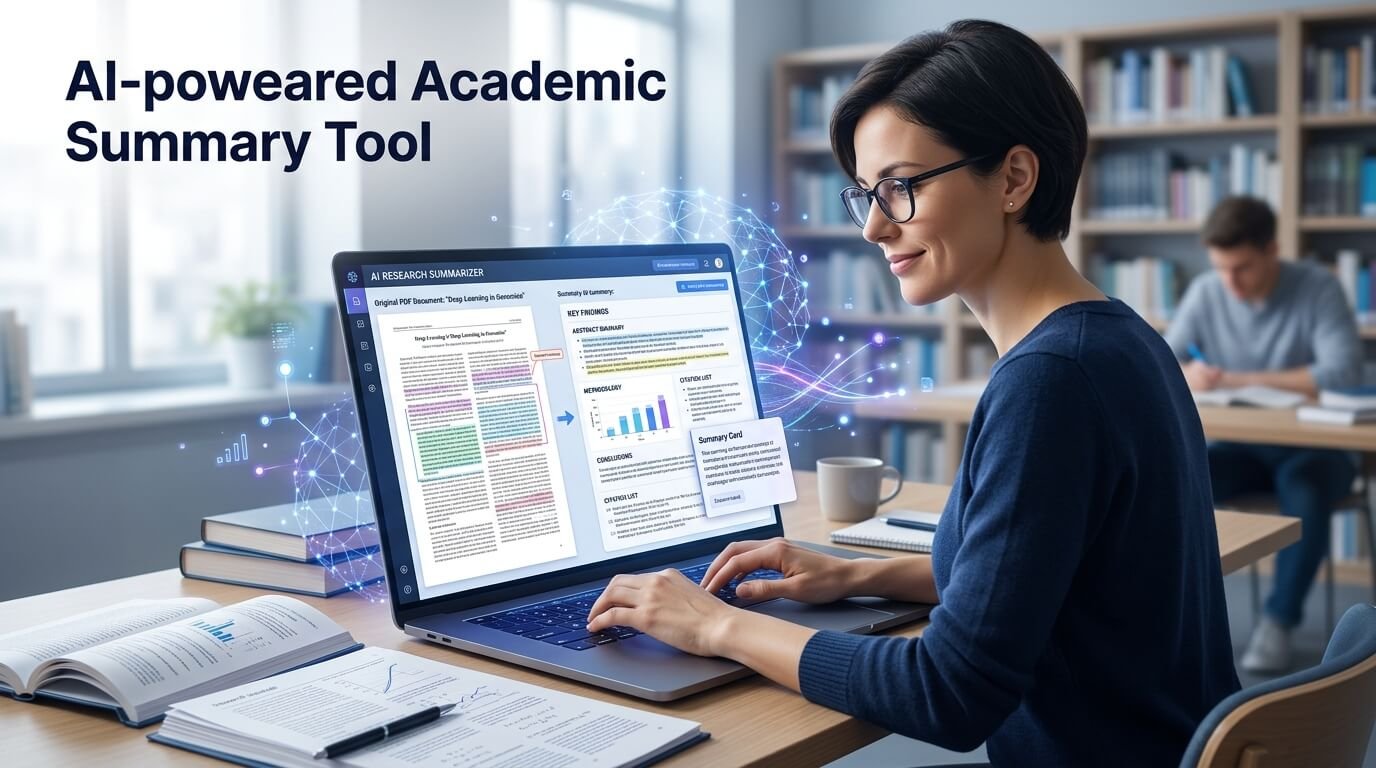
Research papers are packed with information, but that does not mean every reader has the time to work through every paragraph, footnote, methodology section, table, and reference. A single academic paper can take considerable effort to understand, particularly when it introduces unfamiliar terminology or describes a complicated experiment. For students, researchers, academics, journalists, analysts, and professionals who regularly work with technical documents, the challenge is often not finding information but processing it quickly without losing the meaning behind it. That is where AI Tools to Summarize Research Papers and PDFs can become genuinely useful. Instead of treating an AI summary as a replacement for reading, you can use it as a research assistant that helps you identify the paper’s central argument, methodology, findings, limitations, and practical implications before deciding where deeper reading is necessary.
Modern AI assistants can work with uploaded documents, extract important ideas, answer questions about specific passages, compare concepts, and transform dense academic language into clearer explanations. The quality of the result, however, depends heavily on the tool you choose and the instructions you provide. A vague request such as “summarize this paper” may produce something readable but not necessarily useful for serious research. A better approach is to tell the AI what information matters to you, such as the research question, sample size, methodology, statistical findings, limitations, and conclusion. If you are also preparing a research project, you can explore these AI tools for research paper outlines to organize your ideas before moving into the full research process. This article explores the major options, explains how they differ, and shows how to build a practical workflow around them. The goal is simple: spend less time wrestling with documents and more time understanding, evaluating, and applying the knowledge inside them.
Why Researchers Need AI PDF Summarization Tools
The volume of academic information has created a strange problem for modern researchers. Access to information is easier than ever, yet attention has become one of the scarcest resources. A researcher may discover dozens of potentially relevant papers during a literature search, but reading all of them from beginning to end before deciding which ones deserve closer attention can consume days or weeks. AI summarization tools offer a way to perform an initial screening pass. They can help turn a long document into a structured overview, allowing a reader to quickly determine whether the paper actually addresses the question they are investigating.
This is especially valuable when a research project involves a large collection of PDFs. Imagine that you have downloaded 40 papers related to a single topic. Reading every abstract is manageable, but examining the methodology and conclusions of every paper becomes much more demanding. An AI assistant can help organize those documents by extracting recurring themes, identifying differences in research methods, and answering targeted questions. The researcher still needs to make the final judgment, but the preliminary information-gathering stage becomes more efficient. That distinction matters because academic work depends on interpretation, skepticism, and context rather than simply producing a shorter version of a document.
The most effective workflow treats AI as a first-pass research assistant rather than an unquestioned authority. You might ask it to identify the research question, explain the methodology in plain language, list the principal findings, and point out limitations. You can then return to the original paper and verify the important claims. Used this way, AI does not remove critical thinking from the process; it helps direct critical thinking toward the parts of the literature that deserve the most attention.
The Problem With Reading Every Paper Manually
Manual reading remains essential for important sources, but it is not always an efficient first step. Academic papers often contain repeated background information, extensive methodological descriptions, technical terminology, statistical explanations, and references to previous studies that may not be equally relevant to every reader. Someone conducting a literature review might need to understand whether a paper’s sample and methodology are appropriate without initially needing to memorize every detail. The difficulty is that determining relevance can itself require substantial reading. This creates a bottleneck between discovering a paper and deciding whether it deserves close examination.
There is also the issue of cognitive fatigue. After reading several dense papers in succession, it becomes increasingly difficult to maintain a clear mental map of what each study found. Similar terminology can blur together, and researchers can accidentally confuse the conclusions of one paper with those of another. A structured AI-generated overview can serve as a temporary reference point. It can separate one study’s research question, population, intervention, outcome, and conclusion from another study’s details, making comparisons easier.
The key word is temporary. A summary should help you navigate the original source, not become the source itself. If a paper is central to a thesis, dissertation, systematic review, publication, or professional decision, the original text deserves careful examination. AI can identify the important sections, but it may miss a qualification hidden in a paragraph, misunderstand an unusual technical term, or simplify a nuanced finding. The convenience is real, but convenience should never be confused with evidence.
How AI Changes the Research Reading Process
AI changes research reading by making documents interactive. Traditional PDF reading is mostly linear: you start at the abstract, move through the introduction and methods, examine results, and eventually reach the discussion. With an AI assistant, you can ask questions at any point. Instead of reading 25 pages simply to find out how participants were selected, you can ask the system to explain the participant-selection process and identify any inclusion or exclusion criteria described in the document.
To understand the broader technology behind these systems, you can also refer to Artificial intelligence on Wikipedia for an overview of how AI is used to perform tasks that traditionally require human intelligence.
That interaction can also make difficult papers more accessible. A graduate student encountering a complex statistical method could ask for a plain-language explanation without abandoning the paper’s terminology. A business analyst could ask what the findings mean for a particular industry. A medical researcher could request a structured breakdown of the study population, intervention, control group, primary outcome, and limitations. The same PDF can therefore be viewed from different perspectives depending on the reader’s purpose.
This is one reason AI Tools to Summarize Research Papers and PDFs are becoming part of broader research workflows. The real advantage is not merely shortening documents. It is reducing friction between the reader and the information they need. When used carefully, AI can turn a static document into something closer to a question-and-answer research environment. That can save time while still leaving the researcher responsible for verification and interpretation.
What to Look for in an AI Research Summarizer
Choosing an AI summarizer should involve more than asking whether it can “read PDFs.” Many tools can process documents, but their usefulness varies according to file size, context handling, reasoning ability, privacy controls, citation behavior, and the quality of their answers. A tool that produces fluent paragraphs is not automatically a good research tool. For academic work, accuracy and traceability matter more than polished wording. You should be able to understand where a conclusion came from and recognize when the system is uncertain.
Another important consideration is document context. A research paper is not simply a collection of independent paragraphs. The meaning of a result may depend on the methodology used to obtain it, the population studied, and the limitations discussed later in the paper. A useful AI assistant needs enough document context to connect those pieces. Otherwise, it may summarize an isolated result correctly while giving it an incorrect interpretation.
The best tool also depends on your workflow. If you mainly want quick summaries of individual papers, one general-purpose assistant may be sufficient. If you have a large collection of documents and want to ask questions across them, a research-focused notebook or document-analysis platform may be more suitable. Before choosing a service, consider how sensitive your files are, whether you need citations, how often you process PDFs, and whether you need to compare multiple sources rather than summarize one at a time.
Accuracy and Context Preservation
Accuracy is the first quality to evaluate because a beautifully written incorrect summary is worse than no summary at all. AI systems can occasionally produce what researchers call hallucinations: statements that sound plausible but are not supported by the source. This can happen when a document uses unusual terminology, contains complex tables, includes scanned pages, or presents results that require careful statistical interpretation. The risk becomes especially important when the summary concerns numerical findings, causal claims, or methodological details.
A good summarization workflow therefore asks the AI to stay close to the source. Prompts can explicitly request that the system use only information contained in the uploaded document, distinguish between what the authors found and what the AI infers, and quote or identify the relevant section when possible. You can also ask it to state “not reported” when a requested detail is absent instead of guessing. These small instructions can significantly improve the usefulness of an AI-generated research summary.
Context preservation matters just as much. Suppose a paper reports that an intervention was associated with improved outcomes. A poor summary might present that statement as proof that the intervention caused the improvement. A careful summary should explain whether the study was randomized, observational, experimental, or correlational and should preserve the authors’ own limitations. Researchers should be particularly cautious when an AI converts technical findings into everyday language because simplification can accidentally change the strength of a claim.
Citation, Privacy, and File Support
For serious academic work, citation behavior deserves close attention. Some AI tools can point back to sections or passages from a document, while others provide a general summary without clear source references. If you are using an AI system to understand a paper before writing your own work, traceability is extremely helpful. It allows you to return to the original source and verify a statement rather than trusting a generated paragraph simply because it sounds convincing.
Privacy is another factor that should not be overlooked. Research documents can contain unpublished manuscripts, proprietary data, confidential reports, patient information, or material subject to institutional restrictions. Before uploading sensitive documents to any third-party service, review its current privacy policy, data controls, retention practices, and your organization’s rules. Never assume that a tool is appropriate for confidential research merely because it accepts PDF files.
File support can also vary. Some documents contain selectable text, while others are scanned images requiring optical character recognition. Tables, charts, equations, figures, and supplementary material can create additional challenges. A tool that works beautifully with a clean text-based PDF may perform differently when confronted with a scanned dissertation containing complicated tables. Testing a representative document before adopting a tool for an entire research project is a sensible step.
Best AI Tools to Summarize Research Papers and PDFs
There is no single best AI summarizer for every researcher because different tools emphasize different strengths. General-purpose assistants are useful when you want to upload a paper and ask detailed questions. Research-oriented applications can be more convenient when you want to organize multiple sources. Notebook-style tools can be valuable when the goal is to build a question-and-answer environment around a collection of documents.
The following options are widely recognized categories of AI assistants that can be useful for PDF and research-paper analysis. Features, limits, pricing, supported file types, privacy terms, and availability can change over time, so researchers should check the provider’s current documentation before relying on a specific capability.
| Tool | Best suited for | Notable strength | Key consideration |
|---|---|---|---|
| ChatGPT | General research analysis | Flexible questioning and structured explanations | Verify important claims against the PDF |
| Google Gemini | Large-document analysis and research workflows | Strong integration with Google’s ecosystem | Feature availability can vary by plan |
| Claude | Long-form document analysis | Detailed explanations and contextual reasoning | Check current file and usage limits |
| NotebookLM | Source-grounded research | Working with collections of uploaded sources | Best when your workflow centers on a source library |
ChatGPT
ChatGPT can be useful when you want more than a simple summary. After providing a research paper, you can ask it to identify the thesis, explain the methodology, extract the major findings, clarify difficult terminology, or generate questions that you should investigate further. Its conversational format makes it particularly useful for researchers who do not know exactly what they want from a document until they start exploring it. Rather than requesting one summary and stopping there, you can use a sequence of increasingly specific questions.
For example, after obtaining an overview, you could ask the assistant to explain the study’s research design in plain language. Then you might ask what variables were measured, how participants were selected, what statistical tests were used, and whether the conclusions appear consistent with the evidence presented. This creates a layered reading process. The first response gives you orientation, while subsequent questions help you investigate the document.
ChatGPT is also useful for transforming information into different structures. A researcher might request a table containing the research question, sample, methodology, findings, limitations, and implications. Another prompt could ask for a distinction between claims directly supported by the paper and interpretations that require caution. These capabilities make it one of the more flexible AI Tools to Summarize Research Papers and PDFs, particularly when the user’s objective changes from simple comprehension to deeper analysis.
Google Gemini
Google Gemini can be useful for researchers who already work extensively within Google’s productivity ecosystem. Depending on the current version and account configuration, Gemini can support document-based analysis and conversational exploration of information. Its usefulness becomes particularly apparent when research tasks involve moving between documents, notes, and other information sources rather than treating each PDF as an isolated file.
A researcher might use Gemini to obtain an initial explanation of a paper and then ask follow-up questions about its central argument or implications. This can be useful for students who need help understanding dense academic writing before reading the source closely. The assistant can also help turn complicated passages into clearer language, which is valuable when terminology is unfamiliar.
As with any AI system, researchers should verify important claims. The fact that an AI model can discuss a PDF fluently does not mean every sentence is guaranteed to represent the source accurately. Pay particular attention to numbers, causal conclusions, subgroup analyses, and statements about limitations. Tool capabilities and limits can also change, so it is wise to confirm the current feature set before designing an entire research workflow around one service.
Claude
Claude is another general-purpose AI assistant that can be valuable for lengthy documents and detailed analytical conversations. Researchers may find it useful when they want a nuanced explanation rather than a compressed list of bullet points. A long research paper can be examined from several perspectives, allowing the user to ask about argument structure, methodology, evidence, assumptions, limitations, and implications.
One practical advantage of a conversational system is that it allows iterative refinement. You could begin by requesting a 500-word overview, then ask for a section-by-section explanation, and finally focus on one particularly difficult portion of the methodology. This is often more useful than generating one enormous summary that attempts to cover everything at once. The researcher controls the depth as the reading process develops.
Claude should still be treated as an analytical aid rather than an academic authority. If the paper’s findings will influence a publication, thesis, grant proposal, clinical decision, or business recommendation, verify critical details in the source. AI can make complex prose easier to understand, but it does not eliminate the need to examine the study’s actual evidence.
NotebookLM
NotebookLM is particularly interesting for source-based research because it is designed around a collection of supplied materials. Instead of thinking about one PDF at a time, you can build a research notebook containing relevant sources and then ask questions about the material. This approach is useful when your real challenge is not simply understanding one paper but connecting information across several papers.
For example, imagine a literature review involving studies on the same intervention. You could use a source-centered workflow to identify common findings, methodological differences, conflicting results, and recurring limitations. The ability to ask questions across a defined collection can help researchers build an initial map of the literature. That map can then guide a much more deliberate examination of the original papers.
Source grounding is particularly useful because it encourages the researcher to distinguish the supplied evidence from outside information. Even so, “source-grounded” should not be interpreted as “automatically correct.” If a source itself is ambiguous, poorly extracted, or difficult to interpret, the AI can still misunderstand it. Always return to the original document when a claim matters.
How to Summarize a Research Paper With AI
Using AI to summarize a paper effectively is less about pressing an upload button and more about giving the system a clear research task. Start by deciding what you actually need to know. Are you trying to determine whether the paper is relevant? Do you need to understand the methodology? Are you comparing several studies? Or are you looking for evidence supporting a particular argument? Your objective determines the kind of summary that will be useful.
A general-purpose summary can be a good starting point, but it should not be the endpoint. Ask the AI to provide the research question, study design, population, methods, main findings, limitations, and conclusion. If the paper is quantitative, ask for the key numerical results and clarify whether they represent association, correlation, prediction, or causation. If it is qualitative, ask about the participants, data-collection method, analytical approach, themes, and limitations.
The most useful summaries are usually structured around decisions. Instead of asking “What does this paper say?” ask “Is this paper relevant to my research question, and why?” Instead of “Summarize the methodology,” ask “Explain whether the methodology is appropriate for answering the authors’ stated research question.” This shifts the AI from merely compressing text toward helping you interrogate the source.
Uploading and Preparing Your PDF
Before uploading a document, inspect the PDF itself. A text-based PDF is generally easier for AI systems to process than a low-quality scanned document. If the paper contains charts or tables that are central to your question, make sure the chosen tool can handle those elements appropriately. A summary based primarily on extracted text may not capture information that exists only inside an image or complex figure.
It also helps to establish a consistent workflow when processing many papers. Use the same core questions for every document so that the summaries can later be compared. For example, you might always extract the research question, publication year, population, sample size, research design, intervention or exposure, outcome, major findings, limitations, and relevance to your project. Consistency turns individual AI summaries into a useful research dataset.
Do not blindly upload confidential material. Check institutional policies and the provider’s current terms before submitting unpublished or sensitive documents. When working with restricted material, an approved institutional solution may be more appropriate than a consumer-facing AI service. The convenience of summarization is not worth compromising research confidentiality.
Prompts That Produce Better Research Summaries
Prompt quality has a surprisingly large impact on the usefulness of document analysis. A request such as “summarize this PDF” leaves the AI to decide what counts as important. A detailed instruction creates a much clearer target. For example, you can ask for a structured summary containing the research question, hypothesis, study design, sample characteristics, methods, main findings, limitations, and practical implications. You can also ask the system to identify information that the paper does not report rather than filling gaps with assumptions.
Useful prompts can include:
- “Summarize this paper in terms of its research question, methodology, principal findings, limitations, and conclusion.”
- “Explain the methodology as if you were teaching it to a graduate student unfamiliar with this research area.”
- “List the major findings and distinguish statistically significant results from the authors’ broader interpretations.”
- “Identify claims in this paper that appear causal and explain whether the study design supports those causal claims.”
- “Compare the findings in this paper with the other uploaded sources and identify agreements and contradictions.”
The strongest prompt is usually the one connected to your actual research task. If you are preparing a literature review, ask about relevance and methodological differences. If you are studying for an examination, request definitions and conceptual explanations. If you are evaluating evidence, ask the AI to identify limitations and alternative interpretations. Specific questions produce more useful outputs than generic instructions.
AI Summarization for Different Types of Research
Not every academic document should be summarized in the same way. A randomized controlled trial, a qualitative interview study, a theoretical paper, a systematic review, and a technical engineering paper all contain different kinds of information. A generic summary can overlook the details that determine whether evidence is actually meaningful. Good AI-assisted research therefore begins by adapting the questions to the document type.
For empirical studies, methodology and results usually deserve significant attention. For theoretical work, definitions, assumptions, argument structure, and conceptual relationships may matter more. For systematic reviews, researchers need to understand the search strategy, eligibility criteria, included studies, synthesis method, and limitations. For technical papers, equations, algorithms, datasets, benchmarks, and experimental conditions may be central.
This is where AI Tools to Summarize Research Papers and PDFs can become more powerful than ordinary text summarizers. The researcher can instruct the system to use a framework appropriate to the discipline. That does not guarantee correctness, but it encourages the AI to focus on the evidence that actually determines the quality and relevance of the research.
Literature Reviews and Systematic Reviews
Literature reviews can become difficult because their value depends on understanding relationships among many sources. A single-paper summary tells you what one study says, but a research project often needs to know how that study fits into the broader literature. AI can help with this initial mapping by extracting comparable information from multiple papers.
For each source, you might capture the research question, population, methodology, principal findings, limitations, and theoretical framework. Once those elements are standardized, you can ask the AI to identify patterns. Perhaps several studies report similar outcomes but use very different populations. Maybe two studies reach contradictory conclusions because one uses a longitudinal design while the other relies on cross-sectional data. These distinctions are more valuable than simply knowing that the papers “agree” or “disagree.”
Systematic reviews require even greater caution. If AI is used to summarize a systematic review, verify details such as the number of included studies, search databases, eligibility criteria, risk-of-bias approach, and statistical synthesis. A small numerical error can change your understanding of the review. AI is useful for orientation, but researchers should consult the original review when extracting evidence for publication or formal analysis.
Technical Papers and Scientific Studies
Technical papers often create a different challenge because important information may appear in equations, diagrams, tables, algorithms, or highly specialized terminology. A general-language summary can make such a paper feel easier to understand while accidentally removing the details that make the research meaningful. Researchers should therefore ask AI to preserve technical terms and explain them rather than replacing them with vague language.
For scientific studies, prompts can focus on experimental design, variables, controls, measurements, statistical methods, and reproducibility. Ask the AI to distinguish between what was directly measured and what the authors inferred from those measurements. This is particularly important when the paper makes a strong claim based on limited experimental conditions.
For engineering or computer science papers, you can ask for a step-by-step explanation of the proposed method, dataset, baseline comparisons, evaluation metrics, and limitations. If the paper proposes an algorithm, ask the AI to explain what problem it solves, how it works, and how the authors evaluated it. Then verify the explanation against the relevant equations, figures, and experimental sections.
How to Verify an AI-Generated Research Summary
Verification is the step that separates responsible AI-assisted research from careless information consumption. Even the best AI system can misunderstand a sentence, overlook a qualification, confuse two concepts, or reproduce an incorrect assumption. A summary should therefore be considered a navigation aid, not definitive evidence.
Begin by checking the central claim. Does the AI’s one-sentence description of the study accurately reflect the abstract and conclusion? Next, inspect the methodology. Does the summary correctly describe the sample, design, intervention, controls, or analytical approach? Then check the principal results, especially numbers, percentages, confidence intervals, effect sizes, p-values, and other quantitative information.
Pay particular attention to causal language. Researchers often use phrases such as “associated with,” “correlated with,” “predicted,” or “was linked to,” while an AI summary may casually convert them into “caused.” That is not a minor wording issue. It can fundamentally change the meaning of the evidence. If the original study is observational, be especially skeptical of causal statements in an AI-generated summary.
A practical verification routine is to select several important claims from the AI output and locate the corresponding passages in the original PDF. If the AI cannot point you toward supporting text, investigate further. When possible, ask the AI to distinguish direct statements from interpretations. You can also request a “missing information” section so that the model is encouraged to acknowledge gaps instead of creating a complete-sounding narrative.
Benefits and Limitations of AI PDF Summarizers
The biggest benefit of AI summarization is obvious: time. A well-structured summary can give a researcher an initial understanding of a paper in minutes. That makes it easier to screen large collections, identify relevant sources, prepare questions for deeper reading, and organize notes. AI can also make difficult academic language more approachable, which is especially helpful for students and researchers entering unfamiliar disciplines.
Another advantage is interactivity. Traditional summaries are static, but AI allows you to ask follow-up questions. If the first explanation is too technical, you can request a simpler one. If it is too general, you can ask about the methodology. If you want to compare two papers, you can direct the conversation toward their similarities and differences. This flexibility makes document analysis more personalized than conventional summarization.
There are limitations, however. AI may hallucinate details, misread tables, overlook figures, misunderstand terminology, or flatten nuanced arguments. It may also produce an impressively coherent summary that hides uncertainty. The danger is greatest when readers assume that fluent language equals factual accuracy. It does not.
Privacy and intellectual-property concerns also matter. Researchers should understand how a platform handles uploaded documents and should follow institutional rules. In regulated environments, additional restrictions may apply to health, financial, legal, or personally identifiable information. An efficient workflow is only successful when it remains ethically and legally appropriate.
Another limitation is that AI does not replace scholarly judgment. It cannot independently determine whether a study is methodologically sound in the same way an experienced researcher can critically evaluate research design, bias, statistical assumptions, and disciplinary context. It can raise useful questions, but humans must decide how much confidence to place in the answers.
How to Build an AI-Assisted Research Workflow
The most productive approach is to make AI one component of a broader research workflow. Once you have summarized and screened your sources, using AI tools for research paper outlines can also help you organize the key arguments, research questions, and supporting evidence into a logical structure. Begin with discovery and screening. Use AI to determine which papers appear relevant and which can be placed lower on your reading priority list. Then move to structured extraction, asking consistent questions across the papers that remain important.
Next comes verification. Check the claims that matter to your project against the original sources. Keep citations tied to the original paper rather than treating the AI conversation as your evidence. If you are writing academically, maintain a research-management system where source information, notes, quotations, and your own interpretations remain clearly separated.
You can also use AI after reading rather than only before reading. Once you understand a paper, ask the system to challenge your interpretation. For example, provide your understanding of the study and ask what you may have overlooked. This can expose weaknesses in your reasoning and create a useful second-pass review. The AI becomes a tool for intellectual friction rather than merely a shortcut.
A strong workflow might look like this:
- Discover potentially relevant papers.
- Use AI for initial screening.
- Generate structured summaries.
- Compare methods and findings across sources.
- Read the most important papers closely.
- Verify AI-generated claims against the originals.
- Record citations and research notes independently.
- Use AI to test interpretations and identify unanswered questions.
This approach preserves the human role at every important stage while allowing AI to handle repetitive information-processing tasks.
Common Mistakes When Using AI to Summarize PDFs
One common mistake is assuming that the shortest summary is automatically the best summary. A two-paragraph overview may omit the methodological details that determine whether the findings are trustworthy. Another mistake is asking broad questions when a specific research question would produce a much more useful answer. The quality of the interaction often improves when you tell the AI exactly what information you need.
A second mistake is failing to distinguish between summary and analysis. A summary describes what the paper says. Analysis evaluates the evidence, assumptions, methods, and implications. AI can attempt both, but researchers should know which task they requested. If you ask whether a study proves a particular claim, you are asking for evaluation rather than simple summarization.
Another problem occurs when researchers copy AI-generated text directly into academic work. Even if the summary is accurate, it may not reflect your own understanding or the citation requirements of your institution. AI-generated prose should generally function as working material. Return to the source, develop your own interpretation, and cite the original research appropriately.
Finally, never assume that one tool is correct simply because another tool agrees with it. Two AI systems can produce similar errors because they are responding to the same ambiguous source. Agreement between models is not a substitute for evidence in the original paper.
When Should You Read the Full Research Paper?
AI summaries are most useful for deciding how deeply you should read, not whether you should ever read the source. If a paper is directly relevant to your thesis, publication, systematic review, policy decision, or professional recommendation, the full document deserves careful attention. A summary cannot reliably communicate every qualification, methodological choice, statistical caveat, or contextual detail.
You should also read the full paper when the study produces evidence that challenges your existing assumptions. Confirmation bias can become especially dangerous when AI is used as a filter. If you ask an AI to summarize a paper from the perspective of your preferred conclusion, it may organize the evidence in a way that reinforces your framing. Reading the original allows you to encounter the argument more directly.
The full paper is also essential when you need exact quotations, precise statistics, detailed methodology, or evidence for a formal claim. AI can help you locate relevant sections, but the final citation should be based on the original source. Think of the summary as a map. You would not use a map as a substitute for the landscape when the terrain itself matters.
AI Summarization vs. Traditional PDF Reading
AI summarization and traditional reading are not competitors in every situation. They perform different jobs. Traditional reading offers depth, context, nuance, and direct engagement with the author’s argument. AI summarization offers speed, interactive questioning, organization, and rapid orientation.
| Research task | AI assistance | Full reading |
|---|---|---|
| Initial relevance screening | Excellent | Time-consuming |
| Quick overview | Excellent | Slower |
| Understanding unfamiliar terminology | Very useful | Useful |
| Checking exact methodology | Helpful | Essential |
| Evaluating research quality | Supportive | Essential |
| Extracting precise evidence | Requires verification | Essential |
| Comparing many papers | Very useful | Time-intensive |
| Understanding subtle argumentation | Helpful | Essential |
The strongest strategy combines both. Use AI at the beginning to establish context, during reading to clarify difficult sections, and afterward to test your interpretation. This creates a research process in which technology handles some of the repetitive cognitive work while the researcher retains responsibility for judgment.
How Students Can Use AI Research Summarizers Responsibly
Students can gain enormous value from document-analysis tools, especially when they encounter papers written in unfamiliar academic language. A student can ask an AI assistant to explain a difficult concept, identify the argument of a paper, or create questions for self-testing. This can transform passive reading into active learning.
However, students should avoid using summaries as a substitute for assigned reading. Understanding an abstracted version of a paper is not the same as engaging with the author’s evidence. If an assignment requires students to analyze methodology or critique an argument, relying exclusively on an AI summary can leave important gaps in understanding.
A better educational approach is to read the paper, form an initial interpretation, and then use AI to challenge or clarify that interpretation. Ask the tool to explain a difficult paragraph, compare competing interpretations, or generate questions that test your understanding. Then return to the source and see whether the explanation holds up.
Students should also follow their institution’s academic-integrity policies. Different schools and instructors have different rules regarding AI use. Responsible use means knowing those rules, documenting assistance where required, and ensuring that submitted work represents genuine understanding rather than undisclosed automated writing.
How Researchers Can Use AI Without Losing Critical Thinking
There is a subtle risk in making research too convenient. When information becomes easy to summarize, researchers may stop asking whether they understand the underlying evidence. The solution is not to reject AI but to deliberately preserve moments of independent thinking.
One useful habit is to write your own interpretation before asking the AI for analysis. After reading the abstract and key sections, summarize the study in your own words. Then ask the AI to identify weaknesses or omissions in your interpretation. This creates a productive comparison between human reasoning and machine-generated analysis.
You can also ask adversarial questions. Instead of asking, “Why does this study support my hypothesis?” ask, “What evidence in this paper could weaken my hypothesis?” Or ask, “What alternative explanation could account for these findings?” These prompts encourage critical evaluation rather than confirmation.
Used this way, AI becomes more like a research sparring partner. It can suggest angles you have not considered, but you remain responsible for deciding whether those angles are supported by evidence. That relationship is much healthier than treating an AI-generated summary as an authoritative answer.
Conclusion
AI Tools to Summarize Research Papers and PDFs can dramatically improve the way researchers handle large amounts of academic information, but their greatest value comes from being used thoughtfully. They can help screen papers, explain difficult terminology, extract structured information, compare sources, and create an interactive starting point for deeper research. The technology is particularly useful when researchers face dozens or hundreds of documents and need a practical way to determine which sources deserve close attention.
The important boundary is simple: AI summaries are aids to understanding, not substitutes for evidence. A fluent response can still contain an incorrect number, an exaggerated conclusion, or a missing qualification. For high-stakes academic work, verify important claims against the original paper, inspect the methodology, preserve citations, and pay close attention to causal language.
The best workflow combines speed with skepticism. Let AI handle some of the repetitive work involved in navigating documents, but keep human judgment at the center of source evaluation, interpretation, and final decision-making. When you use specific prompts, consistent extraction criteria, careful verification, and appropriate privacy practices, AI can make research reading faster without making your research less rigorous.
FAQs
1. What are the best AI tools to summarize research papers and PDFs?
Several general-purpose and research-focused AI assistants can analyze PDFs, including ChatGPT, Google Gemini, Claude, and NotebookLM. The best choice depends on whether you need individual document analysis, long-document conversations, source comparison, or a research notebook workflow. Always check current features, file limits, privacy terms, and citation capabilities before choosing a platform for serious research.
2. Can AI accurately summarize scientific research papers?
AI can produce useful summaries of scientific papers, but accuracy should never be assumed. Technical terminology, tables, statistical results, figures, and methodological qualifications can be misunderstood. For important research, use the AI summary as a first-pass explanation and verify significant claims directly against the original paper.
3. How can I get a better summary from an AI PDF tool?
Give the AI a specific task instead of simply asking for a summary. Request information such as the research question, hypothesis, sample, methodology, major findings, statistical results, limitations, and conclusion. You can also instruct the AI to state when information is not reported rather than guessing, and ask it to distinguish facts directly stated in the source from its own interpretations.
4. Is it safe to upload research papers to AI tools?
It depends on the document and the service. Publicly available papers generally present fewer confidentiality concerns, but unpublished manuscripts, proprietary research, personal information, and restricted datasets may require special handling. Review the platform’s current privacy and data-retention policies and follow your university, employer, publisher, or research institution’s rules before uploading sensitive documents.
5. Should I still read the original paper after using an AI summarizer?
Yes, particularly when the paper is important to your research. An AI summary is useful for screening, orientation, and identifying sections that deserve attention, but it can omit context or misunderstand nuanced findings. If you intend to cite a paper, rely on the original source for the final evidence, quotation, methodology, statistics, and interpretation.
