
Introduction
Whether you’re a blogger, business owner, freelancer, or digital marketer, having access to a reliable content publishing platform can make a significant difference in your online growth. An account on a trusted article-sharing website gives you a place to publish valuable content, reach a wider audience, and build your online presence over time.
Creating an uploadarticle account is one of the first steps toward sharing your expertise with readers while exploring guest posting and content marketing opportunities. The registration process is straightforward, making it suitable for beginners as well as experienced content creators.
In this guide, you’ll learn everything from setting up your profile to managing your account effectively. You’ll also discover useful tips for keeping your account secure, publishing content efficiently, and making the most of the platform’s available features.
Why Create an UploadArticle Account?
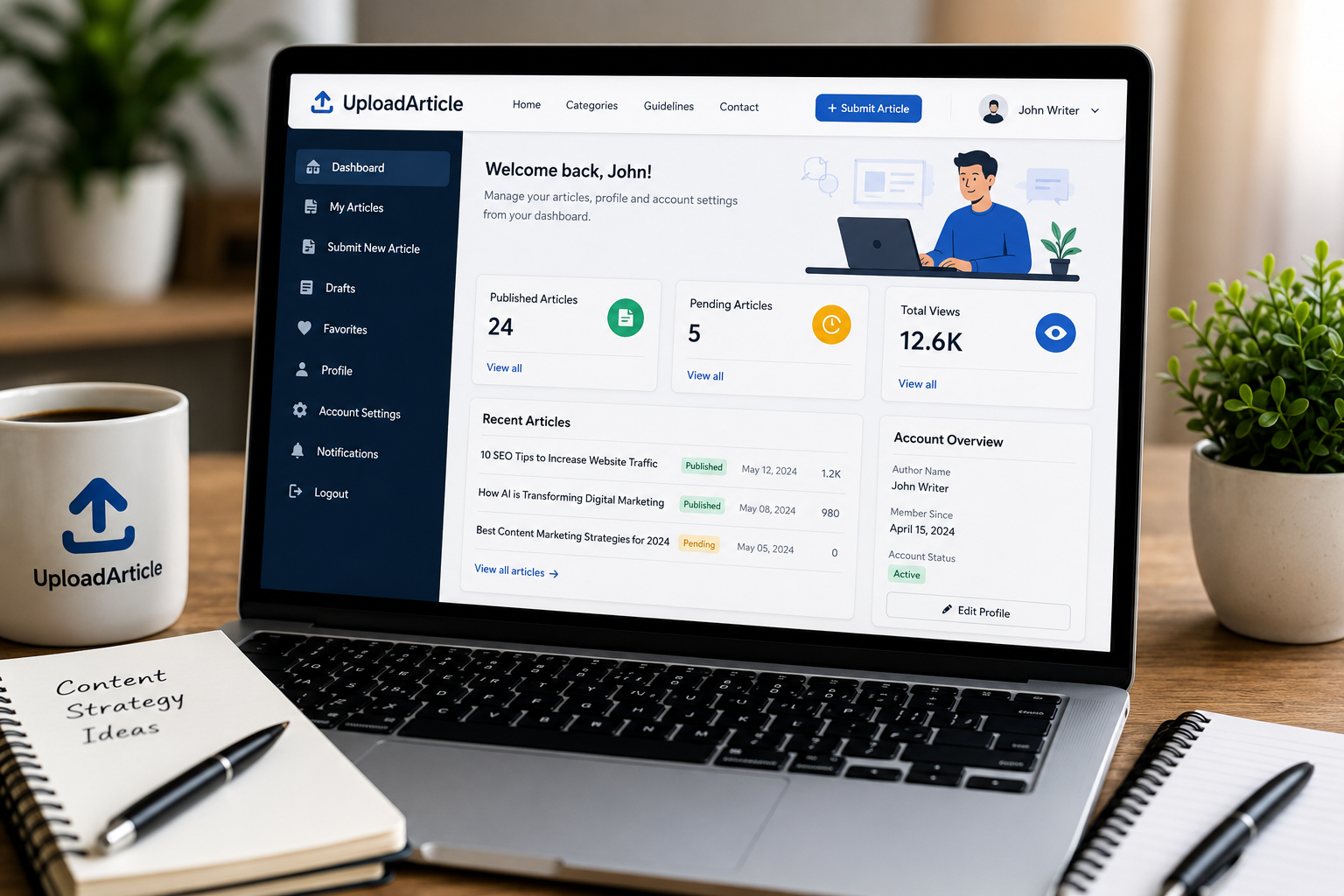
If you regularly publish articles online, keeping everything organized is essential. An account allows you to manage your submissions, update your profile, and monitor your published content from one dashboard.
Instead of sending articles through lengthy email conversations, registered users can often enjoy a smoother publishing workflow. This saves time while making content management much easier.
If you’re interested in building your author profile and understanding how experienced contributors publish content, you can also explore the UploadArticle.com Authors page. It provides useful insights into author profiles and the publishing community.
For business owners, an account can also become part of a broader content marketing strategy. Publishing informative articles helps build authority within your niche while introducing new readers to your brand.
Freelancers and SEO professionals also benefit because they can maintain a portfolio of published work that demonstrates writing quality and industry experience.
Benefits of Having an Online Publishing Profile
Every online publishing platform offers unique advantages, but maintaining an active account generally provides several long-term benefits.
Publishing valuable content is a key part of content marketing, a strategy used by businesses and creators to educate audiences and build trust. To learn more about this approach, you can read the Wikipedia article on Content Marketing.
Some of the most valuable advantages include:
- Easier article submission
- Faster content management
- Access to author profiles
- Better organization of published articles
- Opportunities to build online credibility
- Improved visibility for quality content
Benefits of Having an Online Publishing Profile
Having an online publishing profile can provide much more value than simply giving you a place to upload articles. When you create an uploadarticle account, you establish a central author identity where readers can discover your work, learn about your interests, and understand the subjects you regularly write about. For a blogger, freelancer, business owner, or digital marketer, this type of profile can become a useful part of a broader online presence. Think of it like a digital portfolio that remains available even when you are not actively sending your work to potential clients or readers. Instead of repeatedly explaining what you do, your published articles can demonstrate your knowledge through actual examples.
One of the biggest advantages of maintaining an account is better content organization. Writers who publish across different websites often end up with articles scattered between email conversations, word-processing documents, cloud folders, and publishing platforms. After a while, it becomes surprisingly difficult to remember where a particular article was published or which topics have already been covered. A dedicated author profile gives you a more structured place to manage your published work. You can review previous articles, identify subjects you have already discussed, and use that information when planning future content. This is especially useful when you publish regularly or manage content for several clients.
An active publishing profile can also contribute to professional credibility. Readers are often more comfortable with authors who provide a clear identity and a history of useful contributions. A complete profile does not automatically make someone an expert, of course, but a consistent collection of accurate and informative articles can provide evidence of experience. When visitors can see several pieces connected to the same author, they have an opportunity to evaluate the quality of that person’s work for themselves. This is much more persuasive than simply claiming to be knowledgeable.
For freelancers, an uploadarticle account can also serve as part of a writing portfolio. Imagine a potential client asking whether you have experience writing about technology, marketing, business, finance, travel, or another specialized subject. Rather than sending a generic introduction, you can point to relevant examples of your published work. Those examples allow the client to evaluate your writing style, organization, research ability, and understanding of the subject. A strong portfolio can therefore make conversations with potential clients easier because your work provides something concrete to discuss.
Business owners can benefit in a slightly different way. Publishing useful articles gives a business an opportunity to demonstrate knowledge without making every interaction feel like an advertisement. Suppose someone is researching a problem related to your industry and comes across an informative article associated with your professional identity. If the article genuinely answers their question, the reader may begin to associate your name or brand with useful information. That relationship can become valuable over time because people are generally more likely to remember businesses that help them before asking them to buy something.
An online publishing profile can also support a wider content marketing strategy. Content marketing is based on creating and distributing useful information to attract and educate an audience. Articles can answer common questions, explain complicated subjects, provide practical guidance, or explore industry developments. The goal is not simply to produce as many pages as possible. The real objective is to create content that gives readers a reason to spend time with your work and potentially explore more of what you offer.
Another benefit is the opportunity to develop a recognizable author identity. If you consistently write about related topics, readers may begin to associate your name with a particular area of knowledge. For example, a writer who regularly publishes practical articles about SEO, content creation, and digital marketing can gradually establish a recognizable professional focus. This does not happen after one article, and it should not be rushed. Authority develops through repeated exposure to useful information and a consistent standard of quality.
There can also be networking opportunities. Publishing helpful content may put your work in front of other writers, editors, marketers, entrepreneurs, and professionals who share similar interests. Someone may discover an article through a search, find your author profile, and then become interested in your other work. Not every article will create a business opportunity, and it would be unrealistic to expect that. However, maintaining a professional publishing presence increases the number of places where people can discover what you do.
A publishing account can also help you track your own development as a writer. When you look at your earlier work after several months, you may notice improvements in sentence structure, research quality, organization, and depth. You may also notice recurring weaknesses, such as overly long introductions, repetitive explanations, or unclear conclusions. Your published archive therefore becomes more than a collection of articles; it becomes a record of your development. Reviewing older work can help you identify patterns and make deliberate improvements in future articles.
Quality should always remain more important than quantity. Publishing a large number of weak or repetitive articles may increase the size of your profile, but it does not necessarily increase trust. In some cases, it can do the opposite. If a reader visits your profile and finds several poorly researched pieces, excessive promotional language, or repetitive content, their overall impression may become weaker. A smaller collection of thoughtful articles can be more valuable because every piece contributes positively to your professional identity.
Your profile should also be kept accurate and up to date. If your professional interests change, update your biography accordingly. If you have developed expertise in a new area, consider reflecting that in your author information. Likewise, review older articles when necessary, particularly if they contain information that may have changed. Keeping both your profile and your content current shows that you take your publishing presence seriously.
For SEO professionals and digital marketers, an author profile can be one component of a larger visibility strategy. However, it is important not to reduce every publishing activity to link building or keyword placement. Search engines increasingly focus on whether content satisfies users and provides useful information. Articles created purely to manipulate rankings can offer little value to readers. A much stronger approach is to create genuinely useful content first and then optimize it naturally so that interested people can discover it.
Ultimately, an online publishing profile works best when you treat it as a long-term digital asset. Your account can bring together your articles, author identity, professional interests, and publishing history in one place. The benefits may not appear immediately, but consistent effort can gradually create a stronger online presence. Whether your goal is to attract readers, demonstrate expertise, support a business, build a portfolio, or simply share knowledge, a well-maintained uploadarticle account gives you a structured foundation from which to grow.
Setting Up Your UploadArticle Account Correctly
Creating an account usually takes only a few minutes, but spending a little extra time completing your profile can make a noticeable difference.
Choose a Professional Username
Select a username that reflects your personal brand or business name. Avoid random numbers or confusing spellings whenever possible.
A professional username makes your profile easier to remember and builds trust with readers.
Add an Informative Profile
Your author biography should briefly explain who you are, what topics you write about, and why readers should trust your content.
Keep your introduction concise while highlighting your experience, expertise, or professional interests.
Use a High-Quality Profile Picture
A clear professional photo helps personalize your profile.
Readers are generally more likely to engage with content published by authors who present a complete and authentic profile.
Essential Features Every User Should Know
Most article publishing platforms include several useful features designed to simplify content management.
After creating your account, take time to explore the dashboard carefully. Becoming familiar with available options will help you work more efficiently in the future.
Common features often include:
- Article submission tools
- Draft management
- Author profile editing
- Published article history
- Content review status
- Password management
- Notification settings
Essential Features Every User Should Know
After creating an uploadarticle account, one of the first things worth doing is becoming familiar with the features available inside your account. Many new users focus immediately on publishing their first article and overlook the settings and tools that can make future publishing much easier. Spending a little time exploring the dashboard can save you from unnecessary confusion later. It also gives you a better understanding of how your articles, author information, submissions, and account preferences are organized.
The first feature you should understand is the article submission process. Before uploading an article, review the platform’s current requirements carefully. Publishing websites can have their own rules regarding article length, formatting, originality, external links, promotional language, categories, and acceptable topics. These requirements may change over time, so it is better to check the current guidelines before every major publishing campaign rather than relying entirely on what worked in the past. A few minutes spent reviewing the requirements can prevent avoidable delays and revisions.
The submission process should also be treated as the final stage of your content workflow, not the first. Ideally, an article should already have a clear title, logical structure, properly formatted headings, accurate information, and a completed proofreading pass before you upload it. If you discover major problems only after opening the submission page, you may end up rushing through important edits. Preparing your article beforehand allows you to use the publishing interface efficiently and concentrate on presenting your work professionally.
Another useful feature to understand is draft management. If your account allows you to save unfinished articles, take advantage of that option. Not every first draft deserves immediate publication. Writing an article and editing an article require different mindsets, and separating those stages can improve quality considerably. After finishing your initial draft, step away for a while and return to it later. You may notice repeated ideas, unclear sentences, missing information, or awkward transitions that were difficult to see during the first writing session.
Your author profile is another important part of the account. The profile should provide readers with enough information to understand who you are without turning into a long sales pitch. Use a professional display name, an appropriate profile image, and a concise biography that explains your background and the subjects you write about. If you are a freelancer, business owner, consultant, or specialist, mention your relevant area of experience. The objective is to give readers context and confidence without overwhelming them with unnecessary information.
A strong author biography can also make your articles feel more personal. Readers are not simply interacting with a collection of words; they are reading material created by a person with a particular perspective and area of knowledge. When the profile and articles support each other, your overall online identity becomes more coherent. For example, if your biography describes an interest in digital marketing but your published articles consistently discuss SEO, content strategy, and online branding, readers can quickly understand your professional focus.
The published article history is another feature that becomes increasingly valuable as you publish more content. When you have only one or two articles, remembering what you have written is easy. After several months of regular publishing, however, your archive can become much larger. Reviewing previous publications helps you avoid accidentally covering the same topic repeatedly and allows you to identify areas where additional content might be useful.
Your published history can also help you evaluate your own writing progress. Compare an older article with a more recent one and look at the differences in structure, vocabulary, research, and clarity. You may discover that your introductions have become stronger or that your headings are now more descriptive. This kind of self-review is useful because professional writing improves through deliberate practice rather than simply through producing more words.
If the platform provides submission status information, learn what each status means. An article may be waiting for review, approved, declined, or awaiting changes depending on the platform’s workflow. Understanding these stages prevents unnecessary confusion. If an article has been returned for revision, read the feedback carefully rather than immediately resubmitting the same version. Editorial requirements are usually intended to maintain content quality, so treating feedback as an opportunity to improve can make future submissions smoother.
You should also pay attention to account notifications. Important messages about submissions, profile changes, security issues, or platform updates may be delivered through your registered email address or account dashboard. Make sure the email connected to your uploadarticle account is accessible and current. If notification preferences are available, configure them so that you receive useful updates without being overwhelmed by unnecessary messages.
Password and security settings deserve equal attention. Your publishing account contains your profile information and access to your published work, so protecting it should not be treated as an afterthought. Use a unique password rather than reusing the same password across multiple websites. If you suspect that your login details may have been exposed, change the password promptly and review the account for unfamiliar activity. When using a shared or public computer, always sign out after completing your session.
Another feature worth exploring is the ability to edit account information. Your circumstances may change after you create the account. You might move into a new professional field, change your business name, develop a different area of expertise, or decide to focus on a new category of content. Keeping your author information updated ensures that readers receive an accurate picture of your current professional identity.
It is also helpful to understand how categories and article topics are organized if the platform provides these options. Choosing a relevant category can make your article easier for interested readers to discover. Do not select a category simply because it appears popular. Relevance should come first. An article about SEO, for example, should be placed in a category that accurately reflects digital marketing or search optimization rather than an unrelated high-traffic section.
When available, review the platform’s content formatting options as well. Good formatting is not merely decorative. Clear headings, appropriate paragraph breaks, readable spacing, and properly structured lists make an article easier to consume. A technically correct article can still provide a poor experience if readers are confronted with large walls of text or confusing section organization. Before publishing, preview your article if the platform provides a preview function and check how it looks from a reader’s perspective.
You should also become familiar with any rules concerning external links and promotional content. Links can be useful when they provide additional information, support a factual claim, or direct readers to a relevant resource. Problems can arise when an article contains excessive links, irrelevant destinations, or language that makes the entire piece feel like an advertisement. A good rule is to ask whether each link genuinely improves the reader’s experience. If removing a link would make no difference to the article’s usefulness, it may not need to be there.
For users interested in SEO, it can be tempting to treat every available publishing feature as an opportunity to insert keywords. That approach can make content feel artificial. Instead, use keywords naturally within titles, headings, introductions, and body text when they genuinely fit the subject. Your primary objective should remain useful and readable content. Search visibility is valuable, but it should not come at the expense of clarity.
As you become more comfortable with your uploadarticle account, develop a repeatable workflow. You might research a topic on one day, create an outline the next, write the first draft afterward, and then proofread before submitting. The exact schedule does not matter as much as having a process you can repeat. A reliable workflow reduces the temptation to publish rushed content simply because you want to meet a deadline.
Finally, do not assume that you need to use every feature just because it exists. The most useful tools are the ones that support your actual goals. If you mainly use your account to build a writing portfolio, focus on maintaining a professional profile and publishing strong articles. If you manage content for a business, prioritize organization, consistency, and accurate author information. If your goal is to improve your online visibility, pay closer attention to content quality, topic relevance, and reader experience.
The more familiar you become with the platform, the less time you will spend dealing with basic account tasks and the more time you can dedicate to creating valuable content. A well-managed uploadarticle account should make publishing feel organized rather than complicated. By understanding submission tools, drafts, profiles, article history, notifications, security settings, and formatting options, you create a stronger foundation for consistent publishing and long-term content development.
Writing Articles That Get Better Engagement
Creating an account is only the beginning. The real value comes from consistently publishing helpful, original content that readers actually want to consume.
Start by identifying questions your audience frequently asks. Answer those questions in clear language while supporting your points with examples, statistics, or practical advice whenever appropriate.
Instead of writing solely for search engines, focus on helping real people solve real problems. This approach naturally improves readability while supporting long-term SEO performance.
High-quality articles typically include:
- Clear introductions
- Descriptive headings
- Easy-to-read paragraphs
- Helpful examples
- Accurate information
- Logical conclusions
Readers appreciate content that is practical, honest, and easy to understand.
Managing Your Content Efficiently
Publishing articles consistently becomes much easier when you have a clear and repeatable content-management system. Many writers begin with enthusiasm, publish several pieces, and then gradually lose track of topics, drafts, publication dates, and future ideas. The problem usually is not a lack of writing ability; it is a lack of organization. When you manage your uploadarticle account with a simple workflow, you can spend less time trying to remember what needs to be done and more time creating content that readers actually find useful.
The first step is to maintain a central content record. This can be a spreadsheet, document, project-management application, or any other system that you are comfortable using. Keep basic information such as the proposed article title, target topic, primary keyword, intended audience, draft status, submission date, and publication status. If you publish for clients, you can also include the client’s name and project details. The system does not have to be complicated. Its purpose is simply to give you one reliable place where you can see the status of your content.
A content record becomes particularly useful when you publish frequently. Imagine having fifteen article ideas in your head and several drafts saved in different folders. Without an organized system, you may accidentally write about the same topic twice while completely forgetting another important subject. A simple editorial tracker prevents this problem. It gives you a bird’s-eye view of your publishing activity, almost like a map that shows where you have already traveled and which areas are still unexplored.
The next step is to create a topic pipeline. Instead of looking for a new subject only when you are ready to write, continuously collect ideas. Questions from customers, conversations with colleagues, industry news, frequently searched subjects, comments from readers, and problems you personally encounter can all become potential article topics. Keep these ideas in one place and develop them gradually. When it is time to create a new article, you will have a collection of possibilities instead of starting with a completely blank page.
However, collecting ideas is not enough. You also need to prioritize them. Some topics may be highly relevant to your audience but have little practical value, while others may solve an immediate problem. Consider factors such as audience relevance, search interest, business value, originality, and your own expertise. A topic that combines several of these qualities can become a strong candidate for publication. This approach is much more effective than choosing subjects randomly simply because they happen to be popular on a particular day.
Creating outlines before writing can also make your publishing workflow more efficient. An outline allows you to decide what information belongs in the article before you begin writing detailed paragraphs. Start with the main question, then identify the supporting points a reader needs to understand. Arrange those points logically so that each section naturally leads into the next. This reduces repetition and makes it easier to produce a comprehensive article without wandering away from the main subject.
Research should happen before or during the drafting stage rather than after publication. If your article includes statistics, dates, technical information, industry claims, or references to specific services, verify those details carefully. Reliable research improves credibility and gives your writing more substance. It also reduces the risk of publishing information that is outdated or inaccurate. When you are uncertain about a claim, investigate it rather than assuming it is correct.
Another useful habit is to separate writing from editing. Trying to create perfect sentences while writing the first draft can slow you down considerably. During the initial writing stage, concentrate on getting your ideas onto the page and developing the article’s main argument. Once the draft is complete, switch into editing mode. At that point, you can improve sentence structure, remove unnecessary repetition, strengthen weak explanations, and correct grammatical problems.
Proofreading should be treated as a separate final step. Even a well-edited article can contain small mistakes that are difficult to notice when you have been looking at the same text for hours. Read the article slowly before submission. Check headings, names, numbers, links, punctuation, spelling, and formatting. If possible, read important articles again after taking a break. A fresh perspective often reveals problems that were invisible during the first review.
It is also helpful to create a pre-publication checklist for your uploadarticle account. The checklist can be short, but it should cover the mistakes you most commonly make. You might check whether the title accurately represents the article, whether the introduction clearly establishes the topic, whether headings are properly organized, whether links are relevant, whether the content is original, and whether the article has been proofread. Following the same process each time reduces the chance of overlooking something important.
Content management also involves keeping track of what happens after publication. Do not assume that your work is finished the moment an article goes live. Keep the publication date and URL in your content record if available. This allows you to find the article later without searching through your entire account history. It can also help when you want to review older content for updates, portfolio purposes, or future content planning.
Older articles deserve periodic attention. Information changes, industries evolve, and readers’ expectations shift. An article that was accurate two years ago may now contain outdated recommendations. Review older publications and determine whether they still provide useful information. If something is no longer accurate, update it when the platform’s policies and editing capabilities allow you to do so. Maintaining existing content can be just as valuable as producing new material.
Another common organizational problem is duplicate or overlapping content. When writers do not keep records, they may publish several articles that answer essentially the same question. This creates unnecessary repetition and can make an author’s profile feel less diverse. Before starting a new article, review your existing topics. If you discover that you have already covered a similar subject, consider approaching the new article from a genuinely different angle rather than rewriting the same information.
If you work with multiple clients, content management becomes even more important. Keep client projects clearly separated and record which articles were written for which purpose. Use descriptive filenames for drafts instead of vague names such as “article-final” or “new-post.” A better filename might include the topic and date. Small organizational habits can save significant time when you are managing dozens of files.
You should also establish a realistic publishing schedule. Consistency does not mean publishing every day. A schedule that you can maintain is more useful than an ambitious plan that lasts for two weeks and then disappears. Some writers may comfortably publish several articles each month, while others may prefer fewer but more detailed pieces. Choose a frequency that gives you enough time to research, write, edit, and review your content properly.
Avoid allowing the publishing schedule to become more important than quality. If you have promised yourself that you will publish five articles this week but only two are genuinely ready, publishing three weak pieces simply to hit the target is rarely a good decision. Your reputation is connected to everything associated with your author profile. It is better to adjust the schedule than to sacrifice the quality of your work.
Efficient content management also means learning from your previous results. Review the subjects you have covered and identify which types of articles seem to attract the most interest from your intended audience. Do not assume that one successful article means every similar topic will perform equally well. Instead, look for broader patterns. Perhaps readers respond well to practical guides, detailed comparisons, troubleshooting articles, or beginner-friendly explanations. These observations can help shape future topics.
At the same time, do not turn your content calendar into a machine that only produces topics based on performance. Some subjects are important because they establish expertise even if they attract a smaller audience. A balanced strategy includes both high-interest topics and deeper pieces that demonstrate knowledge. This combination helps prevent your publishing profile from becoming too narrow or overly dependent on temporary trends.
Your content workflow should ultimately make publishing simpler, not more stressful. The purpose of organization is not to create endless administrative work. It is to remove unnecessary decisions from your daily routine. When you know what you are writing, why you are writing it, where the draft is located, what stage it is in, and what needs to happen next, the entire process becomes more predictable.
An organized uploadarticle account can therefore become a useful part of your long-term content system. By maintaining a topic bank, using outlines, tracking submissions, proofreading consistently, recording published work, and reviewing older articles, you create a process that can scale with your publishing goals. Whether you publish occasionally or manage a large collection of articles, good organization gives your content strategy a stronger foundation and helps ensure that every article receives the attention it deserves.Studying successful contributor profiles can help you improve your own publishing strategy. The UploadArticle.com Authors page is a helpful resource for learning how professional writers present their expertise.
Building Long-Term Credibility
Publishing a single article can give you visibility, but long-term credibility is built through consistency, accuracy, and the quality of the information you provide over time. Readers rarely decide that an author is trustworthy because of one impressive article. Trust usually develops after they encounter several useful pieces of content and notice that the author consistently explains subjects clearly, avoids exaggerated claims, and provides information that can actually help them. This is why an uploadarticle account should be viewed as a long-term professional asset rather than simply a place to publish occasional articles.
One of the most effective ways to build credibility is to establish a recognizable area of expertise. You do not need to describe yourself as an industry-leading expert or make dramatic claims about your abilities. Instead, let the quality of your articles demonstrate your knowledge. When you repeatedly publish well-researched content around related subjects, readers can gradually understand what you know and what type of information they can expect from you. Over time, this consistency can become more persuasive than a long list of impressive-sounding credentials.
For example, someone who regularly publishes thoughtful articles about SEO, content marketing, website optimization, and digital strategy can develop a clear professional identity around those subjects. A reader who discovers one useful article may then explore other publications by the same author. If the additional articles maintain the same standard of quality, the reader receives repeated evidence that the author understands the field. This is how a collection of individual articles can gradually turn into a broader reputation.
Accuracy is one of the foundations of credibility. Before publishing an article, verify important facts rather than relying on memory or assumptions. Check statistics, dates, names, definitions, technical claims, and other information that could affect the reader’s understanding. A small factual mistake can sometimes damage confidence in an entire article. Readers may forgive an occasional typo, but repeated inaccurate information suggests that the content was not properly researched.
This becomes even more important when writing about industries that change quickly. Technology, SEO, social media, online marketing, software, and digital publishing are constantly evolving. A recommendation that was effective several years ago may no longer be appropriate today. If you maintain an active uploadarticle account, periodically review your older content and identify articles that contain information that may have become outdated. Updating old material when appropriate demonstrates that you care about maintaining the usefulness of your published work.
Credibility also depends heavily on originality. Original content does not mean that you must discover a completely new subject that nobody has ever discussed. Most popular subjects have already been covered many times. What makes an article valuable is the way you approach the subject. You can provide clearer explanations, better examples, practical experiences, a different perspective, or a more useful structure. The goal is to give readers a reason to choose your article rather than simply presenting another version of information they have already seen.
Avoid creating articles that merely rearrange information from other websites. Even if the wording is technically different, the result may still feel generic if it adds nothing new. Before publishing, ask yourself a simple question: What does this article give the reader that makes it worth their time? If the answer is difficult to identify, the article may need more research, examples, analysis, or practical guidance.
Your writing style contributes to credibility as well. Professional content does not have to sound complicated. In fact, the ability to explain a difficult concept in straightforward language can make an author appear more knowledgeable because the reader can actually understand the reasoning. Avoid unnecessary jargon when a simpler word communicates the same idea. When specialized terminology is necessary, explain it so that readers who are less familiar with the subject can follow the discussion.
A credible article should also acknowledge complexity when the subject requires it. Avoid presenting every issue as if there is only one possible answer. Some topics depend on circumstances, audience, budget, industry, or individual goals. Explaining these differences can make your content more realistic and useful. Readers tend to appreciate practical guidance that recognizes real-world limitations rather than promising that one strategy will work for everyone.
Consistency matters just as much as individual quality. If your profile contains one excellent article followed by several rushed or repetitive pieces, readers may judge the overall profile based on the weaker material. This does not mean every article must be perfect. It means you should maintain a reasonable standard across everything you choose to publish. If you cannot maintain that standard at a particular publishing frequency, reduce the frequency and give yourself more time to create better work.
This is why publishing schedules should be realistic. You might see other writers publishing every day and feel pressure to match their output. There is no universal requirement to publish at the same pace as someone else. A detailed article that takes several days to research and write may provide more value than several short articles produced simply to meet a numerical target. Your publishing schedule should support quality rather than compete with it.
Another important part of credibility is avoiding excessive self-promotion. Readers generally understand that writers and businesses have goals, but they do not want every paragraph to sound like an advertisement. If an article exists only to promote a product, service, or website, readers may leave before reaching the information they were looking for. Educational content works better when promotion remains secondary to the actual subject.
This does not mean you can never mention your business or services. Contextually relevant references can be useful when they help explain a concept or provide readers with additional resources. The key is balance. Give readers something valuable first. If they find the article genuinely helpful, they are more likely to become interested in the author or business behind it.
Your author profile should follow the same principle. A concise biography that accurately explains your background is usually stronger than a long collection of exaggerated claims. Mention relevant experience, professional interests, and the topics you regularly cover. If your profile changes over time, update it so that it continues to represent you accurately.
Another effective way to build credibility is to specialize without becoming repetitive. You can remain within a particular niche while exploring different questions, audiences, and levels of difficulty. For instance, a digital marketing writer could publish a beginner’s guide to keyword research, an advanced discussion of search intent, a practical article about content audits, and an explanation of common SEO mistakes. These subjects are connected, but each provides a different reason for the reader to engage.
It is also useful to develop a habit of learning continuously. Industries change, new tools appear, and established practices are sometimes replaced. If you continue researching your field, your future articles can reflect current knowledge rather than simply repeating advice you learned years ago. Continuous learning also gives you more material to write about because every new concept, observation, or professional experience can potentially lead to a useful article.
Reader feedback can provide another source of improvement. If readers frequently ask the same question after reading an article, that question may deserve a dedicated explanation in a future piece. If people misunderstand a particular section, the problem may be with the way the concept was explained. Treat feedback as information about how your content is being received rather than as a personal judgment.
Your published articles can eventually form a body of work that demonstrates your professional development. Someone visiting your profile months or years later may be able to see a progression from introductory subjects to more advanced discussions. That progression can make your profile more compelling because it shows continued involvement with your field.
However, credibility should never be confused with popularity. An article that receives a large number of views is not automatically more authoritative than one with a smaller audience. Likewise, a highly searched topic is not necessarily the most valuable topic for your professional identity. Focus on whether your content is accurate, relevant, original, and genuinely useful. Visibility is helpful, but trust is what creates lasting value.
The same principle applies to SEO. Trying to manipulate rankings through excessive keyword repetition, irrelevant links, or low-quality articles can weaken the experience for readers. Search optimization should support the content rather than dominate it. Use relevant terminology naturally, structure your article clearly, and make sure the information satisfies the reason someone would search for the topic in the first place.
Ultimately, building credibility through an uploadarticle account is a gradual process. There is no shortcut that can replace consistent quality. Every article contributes to the impression readers form about you, which means each publication is an opportunity to demonstrate knowledge, reliability, and professionalism. By researching carefully, writing honestly, updating outdated information, avoiding unnecessary promotion, and maintaining a consistent standard, you can turn your publishing profile into a stronger representation of your expertise.
The most valuable result is not simply having a large number of articles attached to your name. It is having a collection of articles that you are comfortable showing to readers, clients, colleagues, or potential business partners. When your published work consistently reflects the quality you want associated with your name, your uploadarticle account becomes more than an account. It becomes part of your professional reputation.
Protecting Your uploadarticle account
Creating an account is only the first step. Keeping it secure is equally important, especially if you regularly publish articles or manage multiple projects.
A strong password should be your first line of defense. Avoid using simple combinations such as birthdays or common words. Instead, create a password that includes uppercase letters, lowercase letters, numbers, and special characters.
It is also a good habit to update your password periodically. If you ever log in from a public computer, remember to sign out after your session ends.
Checking your account settings occasionally can also help you identify outdated information or unfamiliar activity. These simple habits go a long way toward keeping your uploadarticle account safe.
Getting the Most from Your uploadarticle account
Many users create an account and only use the basic publishing features. However, there are several ways to maximize its value over time.
Publish Consistently
Publishing one article every few months rarely produces noticeable results. Instead, develop a realistic publishing schedule that you can maintain.
Consistency helps readers recognize your name while giving search engines more opportunities to discover your content.
Focus on Quality Instead of Quantity
Publishing dozens of low-quality articles rarely builds long-term authority.
Take time to research each topic thoroughly, verify facts, and write content that genuinely answers readers’ questions.
Update Older Articles
Content can become outdated over time.
Refreshing older articles with new information, updated statistics, or improved formatting helps maintain their usefulness and can improve overall performance.
Making these habits part of your routine allows your uploadarticle account to become a valuable asset rather than simply another online profile.
Common Mistakes New Users Should Avoid
Even experienced writers occasionally make mistakes when publishing online.
Some of the most common issues include:
- Publishing duplicate content
- Ignoring grammar and spelling
- Using misleading titles
- Overusing keywords
- Writing overly promotional articles
- Skipping proofreading
- Forgetting to update author information
These mistakes reduce credibility and may affect how readers perceive your content.
Instead, focus on creating informative articles that educate, solve problems, and provide genuine value.
Best Practices for Long-Term Success
Successful authors rarely become recognized overnight.
They build trust gradually by publishing accurate, well-written articles that consistently help readers.
A few simple practices can make a significant difference:
- Research every topic before writing.
- Write naturally for people first.
- Use headings that improve readability.
- Add examples whenever possible.
- Review every article before publishing.
- Keep learning about SEO and content marketing.
- Stay consistent with your publishing schedule.
Following these habits will help your uploadarticle account continue supporting your content marketing efforts for years to come.
How an Account Supports Personal Branding
In today’s digital environment, personal branding is no longer limited to celebrities, influencers, or large business owners. Writers, freelancers, consultants, entrepreneurs, educators, and digital marketers can all benefit from developing a recognizable professional identity online. Your uploadarticle account can support that identity by giving readers a place where they can connect your name with the subjects you understand and the content you publish. Instead of treating your author profile as a simple registration page, think of it as one small part of your overall digital reputation.
Personal branding begins with recognition. When someone encounters your name for the first time, they may know nothing about your experience or interests. One article alone may not tell them much. However, when they discover several useful articles connected to the same author, a clearer picture begins to form. They may notice that you regularly write about SEO, content marketing, technology, business, finance, or another specialized area. That repeated association can help establish a recognizable professional identity.
Your author profile plays an important role in this process. A professional profile should make it easy for readers to understand who you are and what you write about. Use a consistent name across your publishing activities whenever practical, and make sure your biography accurately reflects your professional interests. A clear profile photograph can also make the account feel more personal. These details may appear small, but together they help create a consistent identity.
A useful biography does not need to be complicated. You can explain your professional background, the topics you cover, and the type of information readers can expect from your articles. Avoid filling the biography with exaggerated claims such as calling yourself the best expert in a particular field unless you have a very specific reason to make such a statement. A straightforward description often feels more trustworthy because it gives readers useful context without sounding like an advertisement.
Your published articles are the strongest part of your personal brand because they provide evidence of your communication and subject knowledge. Anyone can write that they are experienced, knowledgeable, or passionate about a particular field. Demonstrating those qualities through actual work is much more convincing. When readers can examine several articles and see thoughtful explanations, accurate information, useful examples, and consistent writing quality, they can make their own judgment about your expertise.
This is particularly valuable for freelancers. Potential clients often want to know whether a writer can handle their subject, understand their audience, and produce readable content. A collection of relevant articles can answer many of those questions before a formal conversation even begins. If your profile contains examples related to the client’s industry, they can immediately see that you have experience communicating about similar topics.
The same principle applies to entrepreneurs and business owners. Your personal brand can support your company’s identity by demonstrating that there are knowledgeable people behind the business. Educational articles can explain industry problems, answer common customer questions, and provide practical guidance. When the content is genuinely useful, it can create a more positive association with your name and professional activities.
However, personal branding should not mean turning every article into self-promotion. There is a significant difference between demonstrating expertise and constantly telling people how knowledgeable you are. If every article repeatedly mentions your company, services, products, or achievements, readers may become less interested in the information itself. A stronger strategy is to make the content useful enough that your expertise becomes obvious through the quality of the explanation.
Consistency also matters across your digital presence. If you use a particular professional name, description, photograph, or area of expertise on one platform and present a completely different identity elsewhere, it can become difficult for people to connect those profiles. You do not need identical wording everywhere, but the fundamental information should be reasonably consistent. This helps create a recognizable professional image.
Your content topics should also support your desired brand. Suppose you want to be recognized as a digital marketing professional. Publishing one article about SEO and then filling your profile with unrelated subjects may make that positioning less clear. There is nothing wrong with exploring different interests, but if your account is intended to support your professional identity, a meaningful portion of your content should reinforce the expertise you want to demonstrate.
At the same time, avoid making your content so narrow that every article feels like a copy of the previous one. A strong personal brand can have a central theme while still covering different questions and perspectives. For example, someone focused on SEO could write about keyword research, technical optimization, content quality, search intent, website audits, local search, and measurement. These subjects create variety while remaining connected to the same professional identity.
Another important factor is writing voice. Readers often remember how an author communicates as much as what the author discusses. You do not need to create an artificial personality, but developing a natural and recognizable style can make your work easier to remember. Clear explanations, practical examples, thoughtful observations, and an approachable tone can all contribute to a stronger author identity.
Your writing should also reflect your intended audience. A technical expert writing for beginners may need to explain concepts differently from someone writing for experienced professionals. Understanding your audience helps you choose appropriate terminology, examples, and depth. When readers feel that an article was written specifically for people like them, they are more likely to find the author’s voice relevant and useful.
Trust is another major component of personal branding. Never knowingly publish false information simply because it sounds impressive. Avoid copying other writers’ work, manipulating facts, or making promises you cannot support. Short-term attention gained through exaggeration can create long-term damage if readers discover that the information is unreliable. A professional reputation is difficult to build and surprisingly easy to weaken.
This is why proofreading and fact-checking should be considered branding activities rather than merely technical tasks. Every public article is associated with your name. A typo does not automatically destroy credibility, but a pattern of careless writing can affect how people perceive your professionalism. Before publishing, read your article from the perspective of someone encountering your name for the first time. Ask whether the article represents the standard you want associated with you.
Your uploadarticle account can also become a useful record of professional growth. Early articles may reflect the knowledge and writing ability you had at the beginning of your career, while later pieces may demonstrate greater depth and confidence. That progression can be valuable. It shows that your professional identity is not static and that you continue learning and developing your expertise.
You can strengthen this effect by gradually moving toward more sophisticated topics. Start with accessible guides if your audience needs them, then introduce deeper analysis as your knowledge and readership grow. This creates a natural progression that can help establish authority without requiring you to make direct claims about being an expert.
Personal branding also benefits from long-term consistency. Publishing ten articles in one month and then disappearing for a year may create less recognition than maintaining a manageable schedule over a longer period. You do not have to publish constantly. The important thing is to choose a rhythm that you can realistically maintain while preserving content quality.
Do not measure your personal brand only by immediate traffic. Some articles may receive modest attention but still be valuable because they demonstrate a specific skill or area of expertise. A potential client may discover an older article months after publication and decide to contact you because the subject matches their needs. Your content therefore has value beyond its initial publication period.
It is also useful to periodically review your profile from an outsider’s perspective. If someone discovered your uploadarticle account today, what would they learn about you after reading three or four articles? Would they understand your professional focus? Would they see evidence of expertise? Would the writing appear consistent and trustworthy? These questions can reveal gaps that are difficult to notice when you manage the account every day.
As your collection of articles grows, consider identifying your strongest pieces. These can become representative examples of your work when you communicate with clients, professional contacts, or collaborators. You do not necessarily need to show people every article you have ever published. A smaller selection of high-quality, relevant pieces can create a stronger first impression.
Personal branding should ultimately feel like an extension of your professional work rather than a separate performance. You do not need to manufacture a personality or constantly promote yourself. Focus on becoming genuinely useful to a specific audience. When your articles consistently answer questions, explain difficult subjects, and provide practical information, your reputation can develop naturally.
Over time, an uploadarticle account can become one component of a larger professional presence that includes your website, social profiles, portfolio, business activities, and other publishing channels. Each piece does not need to perform the same function. Some content can educate, some can demonstrate expertise, and some can introduce readers to your professional interests. Together, these elements create a clearer picture of who you are and what you can offer.
The most effective personal brands are built on evidence rather than claims. Your articles are that evidence. Every well-researched explanation, useful example, thoughtful observation, and carefully edited paragraph contributes to the impression readers form about your professional identity. By maintaining a complete profile and consistently publishing content that reflects your knowledge, you can make your uploadarticle account a meaningful part of your long-term personal branding strategy.
As your reputation grows, reviewing established author profiles can provide inspiration for improving your own presence. You can visit UploadArticle.com Authors here to see how contributors build credibility through quality content.
Whether you’re a freelancer, entrepreneur, educator, or digital marketer, maintaining an active uploadarticle account helps establish a stronger online presence.
Conclusion
Building authority online requires patience, consistency, and high-quality content. While creating an account is simple, using it effectively is what makes the real difference.
A complete profile, informative articles, and regular publishing habits all contribute to long-term success. Readers appreciate authors who provide reliable information and practical insights rather than focusing only on promotion.
If you approach content creation with a genuine desire to educate and help others, your uploadarticle account can become an important part of your digital marketing strategy. Continue improving your writing, stay informed about industry trends, and publish content that delivers lasting value. Over time, your uploadarticle account can help you build credibility, expand your audience, and strengthen your professional reputation.
Frequently Asked Questions
1. What is an uploadarticle account?
An uploadarticle account is a user profile that allows you to publish articles, manage your submissions, update your author information, and access platform features.
2. Is creating an account free?
Most article publishing platforms provide free registration, although some may also offer premium features or additional publishing options.
3. Can I edit my published articles?
Many platforms allow authors to update or request edits after publication, depending on their editorial policies.
4. How can I improve my author profile?
Use a professional profile photo, write a clear biography, publish helpful articles consistently, and keep your information updated.
5. Why is profile security important?
Protecting your account helps prevent unauthorized access and ensures your published content remains under your control.
